
Capture
Make public pages, channels and reused claims visible as one inventory.
EmpCo Directive · Provider’s perspective
An editorial guide for marketing, sustainability and product teams and for agencies, written from the perspective of the EmpCo Manager: the legal basis under EU law, examples, workflows and a traceable way to document decisions.
General information from the service provider’s perspective. The EmpCo Manager shows possible findings for internal preliminary review; it does not provide legal advice.
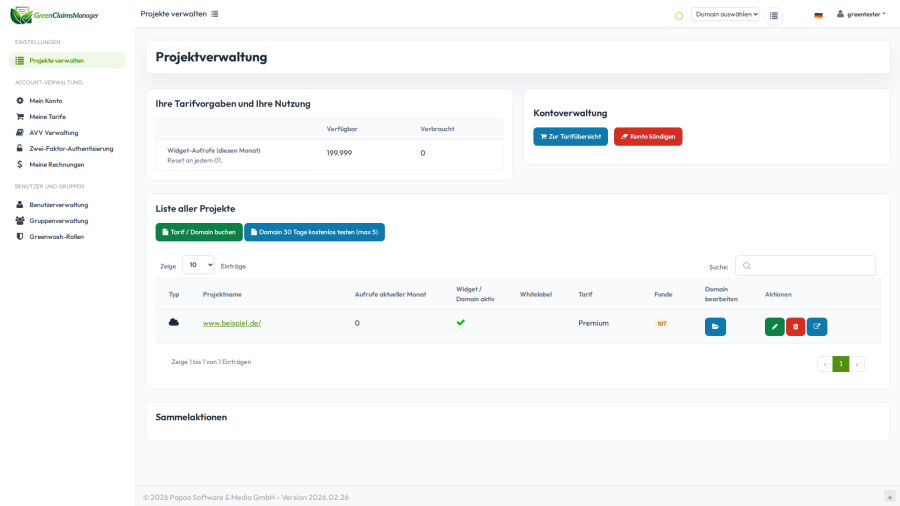
From the EmpCo Manager’s perspective, the service builds on the proven infrastructure of our cookie consent tool CCM19, which has more than 53,000 customers.
The same crawling engine, the same reliability, the same team.


A guide for day-to-day work
This page explains the EmpCo Directive, Directive (EU) 2024/825, and the rules it has added to the Unfair Commercial Practices Directive, from the EmpCo Manager’s perspective. A directive binds the Member States; traders are bound by the national law that implements it. Where national detail matters, the guide uses Germany as an example. It is general editorial guidance from the service provider, not a binding interpretation. A claim should always be assessed together with its design, its subject, its source and its publication status. The chapters show how a team turns possible findings into a documented basis for its work. They do not constitute legal advice.
Repeatable, not improvised
Make public pages, channels and reused claims visible as one inventory.
Consider the subject of the claim, its scope, its context and the possible category separately.
Match product data, certificates, calculations and target plans to the claims.
Record decisions, versions, responsibilities and the next review in a traceable way.
A shared working basis
knows the wording, the tone and how content is actually delivered.
add facts, reference objects, sources and system boundaries.
assesses open questions and decides whether further advice is needed.
EmpCo chapter
The EmpCo Directive creates a European framework for clearer environmental and sustainability communication to consumers. It amends and complements existing EU law on unfair commercial practices and consumer rights. For traders, this does not mean that every ‘green’ word is banned. What matters is the statement, its context, its scope and the evidence on which the claim is based.
Directive (EU) 2024/825 extends, in particular, the rules against misleading commercial practices in the Unfair Commercial Practices Directive (UCPD), Directive 2005/29/EC. The focus is on generic environmental claims, sustainability labels, claims about future environmental performance and information on durability, reparability and software updates. Certain practices have been added to Annex I UCPD (the ‘blacklist’) and are prohibited in all circumstances. Where a communication meets the criteria set out there, no further assessment is needed as to whether it might still appear acceptable in the individual case.
Alongside the blacklist, the general prohibitions of misleading actions and misleading omissions (Articles 6 and 7 UCPD) remain important. A claim can therefore be problematic even where no specific new provision fits exactly. Anyone stating a specific percentage of recycled content, for example, must make clear what the figure refers to and what it is based on, so that it does not suggest a broader effect. A clear specification helps, but it does not replace factual accuracy.
For day-to-day work, it is worth separating the European requirement, its national implementation and the specific publication. The Directive sets out the European objective and amends the relevant EU consumer law acts. As a directive, it binds the Member States, not traders directly: each Member State transposes it into its national law, and traders are bound by the national rules implementing the UCPD. The trader must then look at each publication in its specific medium. Text printed on packaging, a product detail page and a social media post may use the same term and still raise different expectations.
A good internal review therefore does not ask only about the word ‘sustainable’. It also records colours, symbols, labels, product names, images and the statements surrounding them. The EmpCo Manager can automatically scan publicly accessible pages for such signals and organise the findings with risk indicators and confidence levels. The result is a working basis for internal coordination; it is not a binding legal assessment and no substitute for advice from a lawyer.
Marketing, sustainability, product management and legal should keep a shared claims inventory. At a minimum, it records the exact location of the claim, the wording, the advertised item, the reference unit, the source and the date of the last approval. For reused standard text blocks, the inventory should also record the campaigns and sales channels in which they appear.
It is particularly useful to separate the statement from its substantiation. ‘Recyclable’ is a claim. A technical specification, a calculation or a certification can be the supporting document. Only the combination of statement, scope and evidence allows a sound internal decision. Where the data are not sufficient, a narrower wording is often a better next step than a sweeping promise.
Suppose a trader advertises a rucksack as having an ‘environmentally friendly design’. The small print states that part of the inner lining is made of recycled polyester. The headline claim may nevertheless convey more than the explanation. It cannot be justified merely because there is a small material advantage somewhere. A more precise version would state the material, the proportion and the reference unit. Whether that wording is sufficient still depends on the actual characteristics and the way they are presented.
The same applies to images. A leaf symbol, a green colour scheme and an unspecified label can together create the impression of comprehensive environmental performance, even though the text describes only a single characteristic. The inventory should therefore also cover graphic elements and product names. A text scan is a start, but it does not cover every medium.
A practical workflow begins with an unaltered record of the finding. The team first saves the URL, a screenshot or version, the date and the visible context. It then identifies the advertised item and looks for the supporting document, such as a technical specification, a test report or a supplier’s declaration. Only then does it decide whether the statement is to be made more specific, substantiated, replaced or referred for legal advice.
The EmpCo Manager can support the first steps by making possible findings on publicly accessible pages easier to locate. Risk levels and confidence levels help with prioritisation, but they are not legal judgements. Evidence that is not publicly visible, internal campaign briefings and contractual relationships must be added by the responsible teams. This makes clear what was found automatically and which facts a person must confirm.
EmpCo does not require the blanket removal of all environmental communication. Traders can continue to share specific environmental information where the statement fits the advertised item and its basis can be verified. The most important step is therefore transparency about scope and data. Broad terms deserve closer scrutiny; precise terms need matching documentation.
In Germany, the rules have been implemented by the Third Act amending the Act against Unfair Competition (UWG), published in BGBl. 2026 I No. 43. The explanatory memorandum is set out in Bundestag printed paper 21/1855 (BT-Drs. 21/1855).

Note: This article is for general information purposes only and does not constitute legal advice. For a binding assessment of a specific advertising claim, it is advisable to consult a lawyer; national law may differ.
EmpCo chapter
The EmpCo Directive is Directive (EU) 2024/825. Its short name, EmpCo, comes from the words ‘empowering consumers for the green transition’ in its full title. It is intended to protect consumers better against misleading environmental and sustainability information and to give them a more reliable basis for their purchasing decisions. To this end, it mainly amends the Unfair Commercial Practices Directive (UCPD), Directive 2005/29/EC, and supplements the rules of the Consumer Rights Directive, Directive 2011/83/EU.
An EU directive sets a binding objective for the Member States but leaves the specific transposition into national law to them. A directive therefore binds the Member States, not traders directly; traders are bound by the national law that implements it. This is why the EmpCo Directive does not stand on its own alongside national unfair commercial practices law. Anyone who wants to assess an advertising text must read the European requirement, the national rules implementing the UCPD in the Member State concerned and the specific facts together.
In terms of substance, EmpCo has two focal points. First, certain commercial practices have been expressly added to Annex I UCPD. This list is often called the ‘blacklist’; the practices on it are prohibited in all circumstances. Second, the general rules on misleading practices have been made more specific, and new definitions have been added. These include definitions relating to generic environmental claims and sustainability labels (Article 2, points (p) to (r), UCPD), the rules on claims about future environmental performance (Article 6(2), point (d), UCPD) and information duties for services that compare products on environmental or social characteristics or circularity aspects (Article 7(7) UCPD).
The rules do not apply only to traditional advertising. Product detail pages, packaging, newsletters, influencer posts, marketplace descriptions and sales conversations can all contain commercial practices directed at consumers. Whether a sentence is risky therefore does not depend on its wording alone. Imagery, placement, target audience and the scope of the statement also play a role.
In practice, it is also worth noting that EmpCo does not impose a general obligation to produce new scientific evidence for every piece of environmental information. The substantiation must fit the specific claim. A narrow, measurable statement about the proportion of a material requires different documentation from a comprehensive promise about the environmental friendliness of an entire product. Communication should not promise more than the available documents can support.
Traders benefit from a central overview of claims, occurrences and evidence. Such a process can start with a manual inventory. Publicly accessible content can then be searched automatically so that repeated wording and scattered findings become visible. The EmpCo Manager supports this preliminary review by analysing text, image and label signals and listing possible findings with page references.
Responsibility remains with the trader. Teams must take into account the actual product context, internal data, supplier evidence and approval decisions. An automated analysis can help to find and organise this information. It does not make a binding decision on whether the content is lawful and is no substitute for individual advice from a specialist lawyer.
The Directive is not a complete restart of unfair commercial practices law. It amends an existing framework. This matters for editorial work, because the new items on the list are not the only thing that counts. The general provisions against misleading commercial practices (Articles 6 and 7 UCPD, as implemented in national law) can also apply where the overall impression is incorrect. Wording does not become unproblematic merely because it does not appear verbatim in a short list.
At the same time, the Directive must not be read as a blanket ban on sustainability communication. It is intended to improve the quality of information. A trader can, for example, communicate a specific material property, a documented proportion or an objectively described target. The greater the claimed effect, the more carefully the subject of the claim, the time period, the system boundaries and the evidence must be aligned.
In legal terms, ‘commercial practice’ is defined broadly in Article 2, point (d), UCPD. Operationally, however, the analysis does not start with a legal term but with the publication. Besides a claim, a product text can contain an infographic, a symbol or a label. A social media post can link to a landing page whose headline shapes the overall impression. An online marketplace can mix manufacturer information with retailer texts. The documentation should therefore store the published version, not only the original briefing.
For each occurrence, five details are useful: the exact wording, the visible context, the advertised item, the target audience and the underlying document. For recurring standard text blocks, their origin is also recorded. This allows the trader to tell whether the wording needs to be corrected locally or changed in a central content source.
An automated scan is particularly helpful when a domain contains many pages or older content. The EmpCo Manager can bring together possible text, image and label signals and prioritise further review. A finding is an indication of a possible issue. It proves neither that the content is misleading nor that it is lawful. This distinction, in wording and in substance, should also be maintained in internal reports.
The scan is followed by a human review of the facts. The team establishes whether the source is still current, whether it belongs to the product and whether the claim is clearly specified in the medium in which it appears. In case of doubt, the claim is worded more narrowly or referred for an individual legal assessment. In this way, technology supports the process without shifting responsibility.
In Germany, the rules have been implemented by the Third Act amending the Act against Unfair Competition (UWG), published in BGBl. 2026 I No. 43. The explanatory memorandum is set out in Bundestag printed paper 21/1855 (BT-Drs. 21/1855). Anyone assessing a German advertising text therefore reads the Directive, the amended UWG and the specific facts together.

Note: This text provides general legal information and does not constitute legal advice; national law may differ.
EmpCo chapter
EmpCo is relevant for marketing teams because environmental communication arises at many points along the customer journey. A claim does not appear only in a campaign. It can show up in a product name or a filter, on packaging, in a newsletter, in a search engine snippet or in a marketplace listing. In each case, the statement works in combination with its medium. Storing a single sentence in isolation is therefore not enough.
A broad term such as ‘green’ or ‘environmentally friendly’ can create far-reaching expectations. If only a small advantage is described next to it, a gap may open up between expectation and evidence. A specific statement about the proportion of a material has to be assessed differently from the impression that the entire product is superior in every environmental respect.
Marketing should therefore clarify what is being claimed, what the statement refers to and which information must appear in the same medium so that the scope remains clear. A specification that can only be reached after several clicks or in a document that is hard to find does not automatically neutralise the effect of a prominent claim.
Content libraries and central product data save time, but they can spread outdated wording. Short teasers, labels, category headings and automatically imported marketplace fields are particularly vulnerable. A claims inventory should therefore record the original file and the published variants.
Marketing knows the objective and the tone of voice. Product or sustainability teams provide data and system boundaries. Sales and e-commerce know where content is actually displayed. The legal team can assess difficult individual cases. The EmpCo Manager helps to find possible issues on the web and organises them as findings. It does not provide legal clearance and is no substitute for advice from a lawyer.
A sentence from the campaign briefing may be shortened in the shop, sharpened in an advertisement and combined with a different image in the newsletter. These versions do not automatically call for the same assessment. A figure that is explained on a product detail page can convey much more in a short banner without a reference unit. The claims inventory should therefore contain not just the master file, but also the versions actually published.
A simple link between content and placement is helpful. Each claim needs its origin, URL or medium, publication date, target audience and responsible team. For an image, the motif, embedded text and alt text are added. For a label, the documentation records who awarded it, what it covers and for which period the underlying information is valid.
A careful approach does not mean that marketing may only list technical data. It means shaping the creative message so that its core statement does not go beyond the available evidence. ‘Good for the planet’ can become, for example, specific information about the material, its origin or a repair service. The better wording is not automatically the longest one. It is the one whose scope readers can realistically understand.
For new campaigns, a short evidence check in the briefing pays off. Which fact is to be communicated? Who holds the source? How long is it valid? Which limitation must appear in the same medium? If these questions are answered early, there are fewer rounds of corrections between the creative team, the product team and those approving the content.
Once approved, the wording should be versioned in a central register. Whenever the product, supply chain or data basis changes, the team checks whether the statement still fits. A new website scan after a major release can show whether old variants are still accessible. The EmpCo Manager helps to collect findings and make possible repetitions visible. The decision on changes and approval remains with the responsible specialists.
Note: Specific advertising claims should, where necessary, be assessed individually by a lawyer; national law may differ.
EmpCo chapter
For the EmpCo Directive, three things must be kept apart: publication and entry into force at EU level, the deadline for national transposition, and the date from which the national provisions apply. This distinction explains why the Directive has been EU law since 2024, while the specific new national rules implementing the UCPD have applied only since the application date laid down in the Directive, 27 September 2026.
Directive (EU) 2024/825 was published in the Official Journal of the European Union on 6 March 2024 and entered into force on 26 March 2024. Member States had to adopt and publish the necessary national provisions by 27 March 2026 (Article 4(1)). As a directive, it binds the Member States; traders are bound by the national provisions that transpose it.
The key date for communication is 27 September 2026: from that date, Member States must apply their national provisions (Article 4(1), second subparagraph). That date has now passed and the rules apply. Ideally, the inventory of websites, packaging and campaigns began well before that day; any inventory that is still outstanding should be completed without delay. Especially where evidence has to be gathered from different departments, the work needs a reliable process.
| Date | Meaning |
|---|---|
| 6 March 2024 | Publication of the Directive in the Official Journal |
| 26 March 2024 | Entry into force of Directive (EU) 2024/825 |
| 27 March 2026 | End of the transposition deadline for Member States |
| 27 September 2026 | Application of the national EmpCo provisions (Article 4(1)) |
An old publication does not automatically fall outside any assessment just because it was created before the application date. Continued visibility, updates, renewed placement and the specific legal framework can all be decisive. A domain scan can speed up the inventory, but it replaces neither the establishment of the facts nor a legal assessment of the individual case.
The entry into force of the Directive on 26 March 2024 is not the same as the date from which the national provisions apply. Conversely, the transposition deadline of 27 March 2026 did not mean that all the new rules had to be applied in practice on that day. In an internal presentation, each date should therefore always be stated together with its meaning. This makes clear whether the discussion concerns EU law, the national legislative act or operational application.
Nor is 27 September 2026 a switch that automatically settles the status of every individual phrase. The date determines the temporal scope of the new national provisions. The specific assessment still depends on the claim, the medium, the target audience and the facts. A generic countdown is no substitute for an inventory.
Highly visible and frequently reused content should be recorded first, such as homepages, key product pages, campaign landing pages, category teasers and search adverts. Older blog posts, downloadable material and marketplace variants follow, while offline media are recorded separately so that the web scan is not mistaken for a complete inventory.
For each prioritised occurrence, the team records whether it is still live, when it was last changed and whether a source is available. Broad environmental terms, future targets, labels and product-related climate claims deserve closer review. The EmpCo Manager can organise the findings on the web; the responsible department then assesses content and evidence.
Such a timeline is also useful for external service providers. Agencies can see by when briefings should have been updated, and traders can decide which current campaigns need to be re-approved first. The date alone does not decide on a claim, but it creates a shared point of reference for tasks, versions and queries.
Anyone communicating the timeline internally should also record the source of each date. This helps with later updates and prevents a calendar date from an old presentation being passed on. For ongoing editorial work, a short, linked timeline with a clear date of last review is usually sufficient.
In Germany, the rules have been implemented by the Third Act amending the Act against Unfair Competition (UWG), published in BGBl. 2026 I No. 43. The Act appeared in the Federal Law Gazette on 19 February 2026; the EmpCo-related provisions of the amended UWG have applied since 27 September 2026.

Note: For ongoing campaigns and specific transitional questions, an individual legal review is advisable; national law may differ.
EmpCo chapter
The EmpCo Directive entered into force on 26 March 2024, after it had been published in the Official Journal of the European Union on 6 March 2024. Because it is a directive, national transposition is also decisive: it binds the Member States, and traders are bound by the national rules implementing it. Member States had to adopt and publish their transposing provisions by 27 March 2026 and to apply them from 27 September 2026 (Article 4(1)); the national provisions have applied since 27 September 2026.
‘In force’ describes the status of the European Directive. ‘Transposed’ describes the national legislative act. ‘Applies’ refers to the date from which the new national rules are applied in practice. These terms are frequently mixed up in search results and corporate communication.
In an internal project, each date should be given together with its meaning. This avoids presenting an EU act that has already been published as a fully applicable national advertising standard, or confusing the national application date with the end of the transposition deadline.
Preparation should start with existing communication. This includes product pages, category pages, newsletters, social media profiles, packaging, influencer briefings and marketplace data. Recurring standard text blocks deserve particular attention, because a change to a central source can affect many placements. Now that the application date has passed, any of these steps that are still outstanding should be completed without delay.
For each prioritised statement, the team records the wording, its location, the advertised item and the supporting document. The team can then decide whether to word the claim more narrowly, make the specification more visible, add evidence or obtain an individual legal assessment. The EmpCo Manager helps to record publicly accessible findings and flags possible issues. It does not give binding approval.
A good project separates the legal calendar from the editorial calendar. The legal calendar records publication, entry into force, transposition deadline and application. The editorial calendar, by contrast, sets out when content is inventoried, prioritised, revised and republished. There should be enough time between the two calendars for queries. A piece of evidence may, for example, be held by a supplier while marketing is already planning a new product page.
Dates in briefings and approval documents should be written out in full or formatted unambiguously. ‘From 27/09’ may be clear in an internal note, but without the year it can become ambiguous over time. For later updates, it also helps to link the source of the date and to distinguish between the legal position in force and the team’s own planning.
Typical mix-ups arise when one team confuses publication with entry into force, another reads the transposition deadline as the national application date and a third assumes that a page published before the application date is permanently excluded from any assessment. These mistakes often occur at handovers between marketing, product and legal. A short timeline with four labelled stages prevents such misunderstandings.
The EmpCo Manager does not resolve these timing questions automatically. It can, however, help with the inventory if teams document URLs, scan dates and versions together. This shows which version was recorded when and whether a later change triggers a new comparison.
In external communication, the trader should not oversimplify the legal position. ‘EmpCo has applied since 2024’ can be misleading without further explanation if it refers to the application of the national amendments. More precise wording names the Directive, its transposition and its application separately. This strengthens editorial quality and makes later updates easier.
Internal approvals also benefit from this precision. A briefing should state whether a team is explaining the European Directive, describing a national transposition or preparing a publication from the application date onwards. In this way, research, text and approval refer to the same subject, even where the same years appear in all three.
In Germany, the rules have been implemented by the Third Act amending the Act against Unfair Competition (UWG), published in BGBl. 2026 I No. 43. The Act appeared in the Federal Law Gazette on 19 February 2026; the explanatory memorandum is set out in Bundestag printed paper 21/1855 (BT-Drs. 21/1855). The EmpCo-related provisions have applied since 27 September 2026.
Note: This overview of dates is general information and does not replace advice on transitional law in the individual case; national law may differ.
EmpCo chapter
Directive (EU) 2024/825 does not provide for a general additional grace period that exempts all existing advertising until a later date. Under Article 4(1), Member States must apply their national transposing provisions from 27 September 2026, and those provisions have applied since then. Whether a national implementing law contains specific transitional rules has to be checked for the Member State concerned. None of this means that every older statement is automatically unlawful. What remains decisive is the specific claim, its context, its continued use and the relevant provision.
A trader should distinguish between historical records and communication that continues to have a public effect. A completed campaign that is no longer accessible raises a different practical question from a product page that influences purchasing decisions every day. An old claim can also become relevant if it is reused in a new newsletter, updated on a landing page or carried forward in a listing on an online marketplace.
An inventory is therefore more sensible than a blanket deletion exercise. It shows which statements are actually live, what evidence is available and where the scope of a claim does not match the documentation. For high-priority items, the responsible department should decide whether the content is to be adapted, given a clear specification or referred for individual legal advice.
Once the team has identified the most important publicly accessible channels, it marks relevant terms and visual signals and links the findings to product data and sources. The EmpCo Manager can support this first search, but it does not replace the assessment of the evidence.
Existing advertising is not a single block. A printed catalogue may already have been distributed while the corresponding product page is still being changed; an older social media post may remain prominent because it is pinned; and a marketplace text may be republished from a central product database after a revision. The inventory should therefore record the status and reach of each medium.
For old content, too, it is worth looking at the evidence. Data, certificates and supplier declarations may have expired even though the claim has remained unchanged. For a future target, the timetable may have shifted. A label may have a different scope from the one the current product page suggests. These questions call for a prioritised update, not for the assumption of a general transitional period.
For each finding, the team can choose between four next steps: document unchanged, make more specific, temporarily withdraw from communication, or refer for an individual legal assessment. ‘Unchanged’ should only be chosen where statement, context and evidence match. ‘Make more specific’ can add a reference unit, a time period or a limitation. Where content is withdrawn, the team also checks whether the claim continues to be used in other channels.
The EmpCo Manager can prepare this matrix with findings and risk indicators. However, it does not automatically see internal evidence, approvals or contracts. The decision must therefore be taken by a responsible person and documented with date, reasoning and source.
The creation date is a piece of information, but not a blanket licence. For operational purposes, it matters more whether the statement was still publicly visible on the application date, whether it still is today, and how it is updated or reused. In case of uncertainty, the trader should clarify the specific situation with the relevant specialists and, where appropriate, with a lawyer.
A documented decision should also record why content was changed or retained. This allows a later team to understand which source was available at the time and whether the product, the campaign or the legal position has changed since. It prevents the same old wording from being carried over into a new publication without a fresh review of the facts.
In Germany, the rules have been implemented by the Third Act amending the Act against Unfair Competition (UWG), published in BGBl. 2026 I No. 43. The German implementation does not provide for a general additional grace period for existing advertising; the EmpCo-related amendments have applied since 27 September 2026.
Note: Whether a specific older advertisement can continue to be used should, in case of doubt, be assessed individually by a lawyer; national law may differ.
EmpCo chapter
EmpCo concerns commercial practices directed at consumers. There is therefore no general exemption for particular sectors or company sizes. Manufacturers, retailers, service providers, online shops, marketplace operators and the communication partners they commission can all be relevant. Under Article 2, point (b), UCPD, a ‘trader’ also includes any person acting in the name of or on behalf of a trader. What matters is the specific communication to consumers, not merely the number of employees or the legal form.
Several parties can contribute to the same commercial communication. The manufacturer may be responsible for statements on the packaging, product page and data sheet, while the retailer adds its own categories, filters, banners or search texts and an agency drafts the campaign. An influencer may then pick up the claim in a post of their own. Depending on the set-up, responsibility may therefore be shared.
Marketing teams should therefore document the actual channel and the audience. This includes the shop, online marketplaces, social media, newsletters, advertisements, packaging and the point of sale. Offline material and internal contracts must also be added to the process manually. The EmpCo Manager can capture publicly accessible web content in a scan and organise possible findings.
The new items in Annex I UCPD, like the UCPD as a whole, concern business-to-consumer commercial practices (Article 3(1) UCPD) and do not apply to purely B2B communication. A campaign planned as B2B can, however, also be shown to consumers at the same time or actually address private purchasing decisions. In addition, national rules against misleading advertising between traders, which implement Directive 2006/114/EC on misleading and comparative advertising, can be relevant in the B2B sector. Naming the target audience in the marketing plan therefore does not, on its own, answer every legal question.
For publicly accessible content, the EmpCo Manager provides a preliminary review with findings and risk indicators. It does not automatically have access to internal contracts, supplier data or the actual placement logic. Responsibility for context, changes and approval remains with the persons in charge.
Agencies should keep the briefing, the sources and the final publication apart. An agency may draft a claim while the client supplies the actual product information. Anyone adapting a text to several formats should make sure that a necessary specification is not lost in the short format. Approval processes should therefore also cover adaptations for advertisements, social media and newsletters.
For influencer content, the specific post is decisive. A spoken sentence, a label shown on screen and the link to the product page can work together. The client should document its instructions: which statements can be substantiated, which sources may be used and how changes are handled. Merely handing over a general sustainability briefing does not answer the question of which statement actually appears in the finished post.
Marketplaces add another layer. Manufacturer data, retailer descriptions, filters and automatically generated labels can appear side by side. A trader should check whether its own claim is shortened in a platform version or combined with other symbols. The web scan in the EmpCo Manager can capture publicly accessible pages and product texts. Platform-internal fields, contractual relationships and non-public data must be checked separately.
A small team does not need a complex organisational structure, but it does need clear responsibilities. One person maintains the claims register, and a second confirms product data or brings in the relevant specialist. For reused texts, a central spreadsheet with location, claim, subject of the claim, source, status and date is enough to start with. What matters is that the entries are updated whenever something changes.
A page may start out as a B2B landing page and still reach consumers through search engines, retailers or public downloads. Conversely, an offer for business customers does not automatically raise the same expectations as a consumer shop. The actual audience, the sales channel and the presentation should therefore be considered together. The ‘B2B’ label does not relieve the team of this review of the facts.
In Germany, the rules have been implemented by the Third Act amending the Act against Unfair Competition (UWG), published in BGBl. 2026 I No. 43. The new items in the Annex to the UWG concern consumers only, but the general prohibition of misleading commercial practices in § 5 UWG also applies to B2B communication.

Note: Whether a specific communication is directed at consumers may require an individual legal assessment; national law may differ.
EmpCo chapter
EmpCo does not only affect large brands with their own sustainability departments. The decisive question is whether a trader engages in a commercial practice towards consumers, that is a business-to-consumer commercial practice within the meaning of Article 2, point (d), UCPD. Manufacturers, retailers, online shops, service providers, platform operators and commissioned agencies may therefore all be affected; the definition of ‘trader’ in Article 2, point (b), UCPD also covers any person acting in the name of or on behalf of a trader. The size of a company may matter for organisation and resources, but it does not create a general exemption from the rules.
A manufacturer often communicates environmental characteristics on packaging, data sheets and product pages and in campaigns. A retailer may adopt this information but add its own headings, filters, categories or banners. Several different claims can thus arise from the same technical information. The manufacturer might, for example, state the proportion of recycled material, while the shop turns this into a general ‘environmentally friendly product’. Such an extension should not be made without review.
Own-brand products also require clear responsibilities. In that case, the retailer is not merely passing on third-party information but often develops the product, the packaging and the advertising message itself. For every claim, it should be clear who supplies the underlying data and who approves publication. A claims register links the wording to the product, supplier, source, period of validity and medium.
Online shops consist of more than editorial product descriptions. Search filters, labels, range pages, structured data, newsletters and automatically generated teasers can all make environmental characteristics visible. An online marketplace may add its own labels to the information supplied by retailers or take data from a product data feed. The overall visible impression is therefore created by several data sources.
An initial inventory should first record all publicly accessible variants. The EmpCo Manager can scan web pages and present possible text, image and label signals with a reference to the page concerned. Internal feed logic, contract data and platform fields that are not publicly visible must additionally be checked by the responsible teams. The scan is a starting point, not a complete register of all sales systems.
Agencies often produce the concept, copy, images and the variants for each placement. The factual basis, by contrast, usually lies with the client. A robust process therefore separates the briefing, the creative wording, the review of sources and final publication. The briefing should state which environmental effect may actually be claimed, which source supports it and which qualification must remain visible in the same medium.
The specification of a claim is particularly easily lost in adaptations. A detailed product page may explain the share of a material, while the short advert only says ‘green comfort’. The shortened format has to be assessed in its own right. Approvals should therefore cover not only the master text but also banners, social media posts, influencer scripts and marketplace variants.
A small business does not need a complicated committee. A central table recording the claim, where it appears, the subject of the claim, the source, status, date and the person responsible can be a good start. Whenever the product or the source changes, the entry is reassessed. Reused wording is linked to every place where it is used, so that a change is not made at one single URL only.
Priorities can be set according to visibility, reach and the breadth of the statement. A prominent generic claim on the homepage often deserves attention sooner than a precise technical statement in a restricted specialist download. This prioritisation is an organisational decision, not a legal statement on whether a claim is permitted.
Where services are outsourced, the contract should cover more than delivery dates and rights of use. It is also useful to include requirements on sources, changes and approvals. The agency should be able to see which facts have been confirmed by the client and which wording has been newly developed. The client, in turn, should see the final version before it is published across several channels.
A rule for changes after approval is particularly important. If a supplier changes the share of a material or a certificate expires, the old claim must not continue to run without review. A designated owner can update the register and re-scan the affected pages. In this way, the one-off inventory becomes a repeatable process.
When adopting third-party product data, the retailer should also assess the statement in its own context. A manufacturer’s statement may be correct, while the retailer extends it with a new heading. Referring to the data source does not replace this additional review.
Note: Responsibility for specific publications and their legal assessment remains with the companies and specialists concerned; national law may differ.
EmpCo chapter
EmpCo is not tied to any particular technical platform. What matters is commercial communication directed at consumers. An EmpCo inventory should therefore look at digital and physical channels together. A website, online shop, newsletter, search advert, social media, packaging, catalogue, point of sale or a post by an influencer can each convey environmental information.
On a website, environmental claims often appear in the main headline, the product description, the icon bar, the FAQ section, a blog post or an image. Meta descriptions, structured data and search filters add to this. Not all technical information is equally visible to visitors, but a prominent statement can shape the overall impression before any further explanation is read.
Online shops should therefore record product detail pages, categories and search results separately. A filter such as ‘sustainable’ can suggest a verified characteristic, while the products listed behind it are based on different evidence. Newsletters and paid adverts are often fed from templates and may carry old wording forward. A web scan can collect publicly accessible findings; closed mailing systems must additionally be captured through editorial and marketing archives.
A social media post often combines short text, an image, a hashtag and a link. The image may suggest a broader environmental benefit than the caption. An influencer post adds spoken statements, on-screen text and product placement. For documentation purposes, the version actually published should be saved, not only the briefing.
Packaging, labels, catalogues and retail spaces often work without immediate access to further sources. The placement of a specification is therefore particularly important. A QR code can provide further information, but it does not automatically replace a clear explanation of a prominent claim. The specific legal assessment depends on the medium, the claim and the design.
Exhibition stands, product cards and sales conversations can also contain environmental information. A company should check which statements its sales teams use and whether they match the published product data. The process should provide agencies and sales representatives with approved standard text blocks and source references.
Marketplace listings often combine manufacturer data, retailer copy and the platform’s own presentation. An environmental claim can therefore appear in several places. The source must be traceable not only in the CMS but also in the product data feed, the PIM system and the platform account. A change to the central data source should trigger a new review of every place where the information is displayed.
The EmpCo Manager supports web-based preliminary review by structuring possible findings and contextual signals. It does not automatically capture printed material, internal presentations, closed newsletter lists or all platform logic. The inventory therefore combines the scan with a comparison of documents and conversations with the people responsible.
For each channel, a few fixed fields are enough to begin with: medium, URL or location, claim, visible context, target audience, source, date of publication and the team responsible. It should also be noted whether the content is pulled in automatically from another source. This shows where a local correction is sufficient and where a central data set has to be changed.
A page can look different on a desktop, a smartphone and in an app. The specification of a claim should therefore be checked in the most important views. Regional shops, language versions and seasonal landing pages may take the same wording from a shared template but use different product data. The register should link variants instead of treating every URL as an entirely separate case.
For campaigns with a limited duration, the end date is also relevant. An expired banner may remain visible in an archive, a search advert or a social media profile. The documentation should therefore record when a version was published, changed and removed. A repeat scan after the end of the campaign can reveal findings that are still online unintentionally.
The EmpCo Manager concentrates on publicly accessible content. It can search a domain more quickly and provide findings together with contextual signals. It does not replace the review of packaging, sales conversations, internal presentations or closed distribution lists. The scan thus creates a structured basis for further work.
Note: This article is general information and does not constitute legal advice; national law may differ.
EmpCo chapter
An environmental claim conveys that a product, a service, a brand or a trader has a positive or reduced environmental impact, has no environmental impact or has improved its impact over time. Under the definition in Article 2, point (o), UCPD, it is a voluntary message or representation which is not mandatory under Union law or national law. It can arise from words, images, colours, symbols, labels or product names. What counts for the assessment is therefore not only the individual sentence but the overall impression in the medium concerned.
‘Made from recycled material’ ideally describes one specific characteristic. ‘Environmentally friendly’, by contrast, sounds like an overall assessment. The two statements differ in their subject, in their scope and in the evidence they need. Anyone drafting a claim should record whether it relates to the raw material, manufacture, packaging, use, disposal or the product as a whole.
An image can also change the scope. A leaf symbol next to a precise statement about materials may look decorative. Combined with ‘good for the environment’, it may create a much broader impression. A label or a green product colour can reinforce the message further. These elements belong in the claims inventory even where there is no sentence in the traditional sense.
The EmpCo assessment starts with the visible context. A product page with headline, image, label, price and footnote is perceived as a whole. A specification can help if it is clear, prominent and linked to the claim by position or design. Whether that is sufficient depends on the specific design and on how the target audience can be expected to understand it.
A link to an extensive sustainability page does not automatically answer every question. Readers must be able to see what the claim refers to. For a product-related claim, the product, variant, share, period and any relevant limitation should fit together. The level of technical detail may vary from medium to medium, but the core message must not point in a different direction.
General terms such as ‘green’, ‘environmentally friendly’ or ‘climate-friendly’ may require particular attention. The Directive contains specific rules for them: the definition of a generic environmental claim in Article 2, point (p), UCPD and the prohibition in Annex I, point 4a, UCPD. Directive (EU) 2024/825 binds the Member States; traders are bound by the national rules implementing it. A specific statement is not automatically safe if it is incomplete or taken out of context. Even ‘100% recyclable’ can raise questions about the mix of materials, the available infrastructure, the components of the product and the subject of the claim.
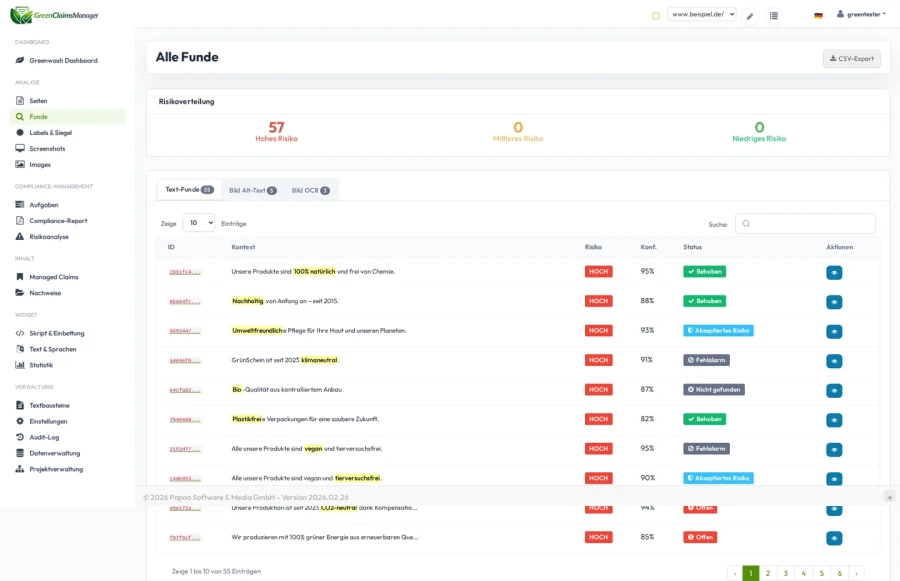
A company should therefore record the exact statement in an internal structure that captures the claim, its subject, the environmental aspect, the metric, the period, the source and the visible specification. This structure helps to distinguish a broad advertising effect from narrow technical information. The EmpCo Manager can locate possible findings in text and image signals and sort them with risk indicators. It does not make a binding assessment of whether the claim is lawful.
Good wording names the specific characteristic first. Instead of claiming a comprehensive environmental effect, a company can describe the share of a material, a repairable component or a documented process step. The sentence must nevertheless be true, up to date and appropriate to the product advertised. Additional information must be easy to find and easy to understand.
The search for evidence starts with a clear description of the claim. ‘Recyclable’ may refer to a single packaging component, the whole packaging set or the product. ‘Climate-friendly’ may suggest a reduction in emissions, a comparison, a target or offsetting. Without this distinction, no suitable source can be selected.
A data sheet can support a technical property, but it does not necessarily support the effect of a general environmental promise. A supplier declaration may be relevant for a material, but it must match the specific product variant and the period concerned. A certificate should show its scope, its period of validity and its issuer. The documentation should not only link to sources but also explain how each source relates to the claim.
The same wording can have a different effect in a technical table from that in a large page header. A prominent claim, a nature photograph and a green label may reinforce each other. A company should save screenshots of the visible presentation, not only the plain text. The same applies to mobile versions and to adverts with limited space.
The EmpCo Manager can help to search for text and image signals. Its risk indicators support prioritisation, but they say nothing about the actual environmental impact. The specialist department must add the product facts, sources and design context. Where a difficult question of interpretation arises, advice from a qualified lawyer is the appropriate next step.

Note: A binding assessment of a specific environmental claim requires an individual legal review; national law may differ.
EmpCo chapter
Under Article 2, point (o), UCPD, an environmental claim is a voluntary communication, not mandatory under Union law or national law, which gives consumers the impression of a positive, reduced or zero environmental impact. It may also claim an improvement over time. The impression can be created by text, image, colour, symbol, label, product name or a combination of these. The question is therefore not only: ‘Does the word “environment” appear?’ It is also: ‘What idea does the presentation as a whole create?’
The obvious forms include words such as ‘sustainable’, ‘climate-friendly’, ‘resource-saving’ or ‘plastic-free’. There are also indirect forms, such as a green leaf used as a product label, a landscape as the dominant motif, a name such as ‘Eco Edition’ or a label without any recognisable explanation. A comparison with a conventional product can also suggest an environmental effect.
The assessment always depends on the context. A text about the packaging is narrower than a statement about the whole product. Information about electricity consumption describes a characteristic in use, not automatically an overall environmental performance. If the narrower content is combined with a large, general promise, however, the overall impression may reach further.
For every finding, the team should note the subject of the claim. Does the statement relate to a component, a product variant, a product line, a company or a business activity? Which stage of the environmental life cycle is meant? Does the period relate to a measurement, a target or an ongoing characteristic? These questions reveal where a claim combines a narrow basis with a broad statement.
A specific figure makes the assessment easier, but it does not automatically settle every question. ‘30% less material’ needs a basis for comparison, a period and an explanation of what the 30% refers to. A certificate must match the product, the variant and the period covered by the claim. The documentation should store this information together with the published wording.
The editorial and, where necessary, legal assessment starts with the meaning the audience is likely to take from the claim. A specialist audience may understand a technical abbreviation differently from a broad consumer audience. This does not mean that companies must simplify every piece of information. They should, however, avoid a situation in which a complex qualification becomes practically invisible next to a very simple headline claim.
Comparisons also belong in the analysis. ‘Better for the environment’ leaves open what is being compared and which environmental aspect is meant. ‘20% less packaging weight than our 2024 variant’ is narrower, but it requires a reliable basis for comparison. The team should therefore record the product compared, the period, the measurement method and the source.
When a finding arises, the editorial team should not simply enter new wording. It records which expectation has been reduced, which reference unit has been added and which source has been used. Whoever works on the next campaign can then understand the decision. The EmpCo Manager supports the collection of findings, but the specialist reasoning and the approval remain outside the automated analysis.
EmpCo supplements the existing rules against misleading commercial practices in Articles 6 and 7 UCPD. Certain patterns are listed specifically in Annex I (the ‘blacklist’) and are prohibited in all circumstances. Beyond that, the overall impression remains decisive where a statement does not literally match a specific prohibition but raises expectations that the facts do not support; Article 6(1) UCPD expressly includes the overall presentation. These levels should be named separately in internal reports.
The EmpCo Manager can locate possible claims and visual signals. Its findings are starting points for establishing the facts. Internal data, supplier documents, actual product characteristics and an understanding of the target audience must be added by people. The system does not give a binding legal decision and does not replace professional advice.
Before publication, an editorial team should read the claim aloud and note the most likely expectation. It then checks whether exactly this expectation is supported by product data and sources. If the sentence sounds broader than the supporting documents, the team can make the reference unit more specific, word the claim more narrowly or obtain a specialist assessment.
In Germany, the rules have been implemented by the Third Act amending the Act against Unfair Competition (UWG), published in BGBl. 2026 I No. 43. As in every Member State, the UCPD reaches traders there through national law. The Act has introduced the new definitions, including that of a generic environmental claim in § 2(2), point 1, UWG. The explanatory memorandum is contained in Bundestag printed paper 21/1855 (BT-Drs. 21/1855).
Note: General information, not legal advice; national law may differ.
EmpCo chapter
Under Article 2, point (p), UCPD, inserted by Directive (EU) 2024/825, a generic environmental claim is an environmental claim which is not included on a sustainability label and where the specification of the claim is not provided in clear and prominent terms on the same medium. Examples are ‘green’, ‘environmentally friendly’, ‘climate-friendly’ or ‘good for the planet’. Such terms are not automatically prohibited because of their wording alone. Under Annex I, point 4a, UCPD, however, making a generic environmental claim is prohibited in all circumstances where the trader is not able to demonstrate recognised excellent environmental performance relevant to the claim; in addition, the effect, scope and basis of the claim must fit together. Directive (EU) 2024/825 binds the Member States; traders are bound by the national rules implementing it, which have applied since 27 September 2026.
A manufacturer may be able to prove a small share of recycled material and still advertise an ‘environmentally friendly product’. The question then is whether the headline claim refers to the entire environmental footprint or only the material aspect that has been substantiated. The more general the term, the more readers expect a comprehensive characteristic. A short explanation can only limit this expectation if it is sufficiently visible and understandable.
A generic claim about a company can also be a problem if only individual projects or sites are meant. The company should therefore make clear whether the statement applies to its entire business, a product line, a branch or a programme of limited duration. An unclear scope is a practical warning sign.
For generic environmental claims, the EmpCo rules focus on the relationship between the generic claim and a clear specification. In practice, the specification should be immediately understandable, visible and linked to the claim. A hidden link, a barely legible footnote or a separate report does not automatically meet the expectation created by the headline claim.
The design is therefore part of the documentation. Screenshots, versions and the mobile display should be saved. A note that is visible on a desktop may slip further down on a smartphone. A banner may repeat a statement without carrying the specification with it. The process should capture such variants.
‘Our shirt is environmentally friendly’ is broad. ‘The shirt contains 70% recycled polyester, measured by the total weight of the outer fabric; basis: supplier declaration dated …’ is narrower and provides a reference unit. The narrower statement must also be factually correct and match the specific variant. It shows, however, how a company can bring its communication closer to its data.
The EmpCo Manager helps to find general terms on publicly accessible pages and to sort them by location. It does not decide which expectation arises in the individual case. That assessment depends on layout, target audience, product and evidence and remains the task of the responsible specialists.
The team should record which environmental effect the claim suggests, which product is advertised, where the source is and whether the specification on the same medium actually stands out. It also checks whether image, colour, label and product name extend the message. If the answers do not match, three options are available. The team can word the claim more narrowly, add a visible explanation or obtain individual advice.
An online shop can show several paragraphs next to a claim, while a search advert offers only a few characters. On packaging, space is limited; a QR code can give access to further information. These differences do not justify contradictory statements. They do show, however, that the specification has to be planned and documented for each medium.
In a banner, the core message should already be narrower, rather than combining a comprehensive promise with a barely visible qualification. On a product page, a table with reference unit and source can help. In a sales conversation, staff must describe the same scope as the approved documents. The process therefore connects editorial work, sales and product data.
A generic claim can be revised by naming the environmental aspect, the product and the reference unit. The company may also decide to use the term only in a clearly delimited section. Whether this change is enough depends on the individual case. The purpose of the inventory is not to remove as many words as possible but to make communication more traceable.
The EmpCo Manager can help to find recurring generic terms across a domain. A result with several findings shows where a central content source needs to be adjusted. It does not mean that every finding has the same legal significance. The people responsible check context and source one by one.
In Germany, the rules have been implemented by the Third Act amending the Act against Unfair Competition (UWG), published in BGBl. 2026 I No. 43. Article 1, points 2 and 7, of that Act has inserted the definition of a generic environmental claim as § 2(2), point 1, UWG and the prohibition of Annex I, point 4a, UCPD as No. 4a of the Annex to § 3(3) UWG. The reasoning is set out in the explanatory memorandum in Bundestag printed paper 21/1855 (BT-Drs. 21/1855).
Note: The assessment of a specific generic environmental claim may require review by a qualified lawyer; national law may differ.
EmpCo chapter
Directive (EU) 2024/825 has added several expressly listed commercial practices to Annex I UCPD, the list of practices which are regarded as unfair in all circumstances. The Directive binds the Member States; traders are bound by the national provisions implementing it, which have applied since 27 September 2026. The term ‘blacklist’ describes practices which are prohibited once their conditions are met, without any further assessment of the individual case. The individual points must not be reduced to a blanket list of arbitrary ‘green’ words.
The new entries concern, among other things, sustainability labels (Annex I, point 2a, UCPD), generic environmental claims (point 4a) and environmental claims that overstate their scope (point 4b), product-related climate claims based on the offsetting of greenhouse gas emissions (point 4c), and statements about software updates, durability and reparability (points 23d to 23j). Point 10a also covers presenting a requirement imposed by law on all products within the relevant product category on the Union market as a distinctive feature of the trader’s own offer. Each entry has its own conditions and its own subject matter.
A label that is not based on a certification scheme within the meaning of Article 2, point (r), UCPD has to be assessed differently from a label established by public authorities. A general term such as ‘green’ follows a different logic from a climate claim that relies on offsetting. Internal documentation should therefore not simply say ‘EmpCo prohibition’ but name the possible entry and the facts relevant to it.
The blacklist is not a dictionary that marks every occurrence of ‘sustainable’ as an infringement. What matters are the wording, design, product, target audience and the conditions of the relevant entry. An automated finding can point to a possible entry. It does not prove that all its conditions are met.
The EmpCo Manager supports initial sorting by structuring findings, text signals, images and labels. Teams can then check which documents exist and whether the statement is actually directed at consumers. Showing a possible provision is an aid to work and documentation, not a binding legal assessment.
Prominent generic claims, own labels, claims of climate neutrality and promises about future environmental performance are recorded first; the latter fall under Article 6(2), point (d), UCPD rather than the blacklist. They are followed by statements about durability, repair, software updates and statutory minimum requirements. For every finding, the version, context, product, source and responsible team are stored. A screenshot is particularly important where layout and emphasis influence the scope of the claim.
If a finding is confirmed, the company can make the statement more precise, make its basis more visible or submit the publication for an individual legal review. Deleting the claim is not always the only option. Equally, a small footnote does not automatically provide the required clarity.
Even where a finding cannot be clearly assigned to a specific entry, the general rules against misleading actions and misleading omissions (Articles 6 and 7 UCPD) may remain relevant. Conversely, a risk indicator must not automatically be taken as proof of an infringement. A clean report separates the finding, the possible rule, the known facts, the open questions and the next decision.
A good internal record of a finding starts with what was observed and then adds the possible entry with a short explanation. A third field records the facts that are still open, such as the issuer of a label, the reference unit of a claim or the basis of a climate comparison. Only then is an action decided. This order prevents an assumption from being passed on as an established result.
On a large website, teams can prioritise by topic. They first collect highly visible generic claims and labels, then statements about product life, software updates and repair. The team then names the responsible specialists for each group. A scan can reveal repetitions, but the approval must also take offline and platform material into account.
Reports should distinguish ‘possible issue’, ‘fact to be clarified’ and ‘next step’ from a legal conclusion. This is more than cautious language. It makes the working basis for marketing, the product team and legal advisers more reliable. The EmpCo Manager therefore uses risk indicators and confidence levels instead of claiming to make a binding decision.
In Germany, the rules have been implemented by the Third Act amending the Act against Unfair Competition (UWG), published in BGBl. 2026 I No. 43. The new entries appear in the Annex to § 3(3) UWG; the explanatory memorandum is contained in Bundestag printed paper 21/1855 (BT-Drs. 21/1855). Points 2a, 4a, 4b, 4c and 10a keep the numbering of Annex I UCPD, while points 23d to 23j of Annex I UCPD appear in the German Annex as a single No. 23d with letters (a) to (g).

Note: The blacklist explains legally defined categories of practices and does not replace a review of the specific facts; national law may differ.
EmpCo chapter
Commercial practices listed in Annex I UCPD are regarded as unfair in all circumstances (Article 5(5) UCPD). Once their conditions are met, they are prohibited without any further assessment of the individual case. This does not mean that every similar word automatically falls into this category. The specific presentation must meet the conditions of the relevant entry. Careful assessment therefore remains necessary.
The relevant areas include sustainability labels which are not based on a certification scheme or established by public authorities (Annex I, point 2a, UCPD), generic environmental claims for which the trader cannot demonstrate recognised excellent environmental performance relevant to the claim (point 4a), environmental claims that overstate their scope to the entire product or business (point 4b) and product-related climate claims based on the offsetting of greenhouse gas emissions rather than actual reductions (point 4c). Further entries concern software updates, durability, reparability, consumables and spare parts (points 23d to 23j). Point 10a separately covers presenting requirements imposed by law on all products within the relevant product category on the Union market as a distinctive feature of the trader’s offer.
These topics overlap in communication, but they are not identical. An own logo may raise a label issue, while a text such as ‘climate neutral’ may require a different review. A statement such as ‘with free updates’, by contrast, concerns product life and software. The report should therefore describe the specific facts instead of using only a collective term.
An automated finding does not in itself establish that the conditions of an entry are met. The team must check whether the communication is directed at consumers, which product or service is affected, which statement was actually visible and whether the conditions laid down by law are fulfilled. Version, period and context may also be decisive.
The EmpCo Manager can locate findings on publicly accessible pages and assign possible rules as risk indicators. This helps to prioritise large volumes of content. The system does not automatically have access to internal contracts, technical evidence, supplier relationships or the full roll-out of a campaign. The final assessment remains with the people responsible and, where necessary, with legal advisers.
The EmpCo rules do not only address classic environmental words. Statements about durability or reparability can create expectations about how long a product can be used. Statements about software updates should match the software updates actually offered. Spare parts, consumables and accessories must not be presented in a way that suggests broader availability or compatibility than the company’s data support.
Statutory requirements should likewise not be advertised as a special achievement of the trader if the product merely meets an obligation that applies anyway. Annex I, point 10a, UCPD prohibits in all circumstances presenting requirements imposed by law on all products within the relevant product category on the Union market as a distinctive feature of the trader’s offer; other cases are assessed under Article 6 UCPD. Factual information may still be useful. What matters is whether the obligation is turned into an additional, voluntary benefit. The exact assessment depends on wording and design.
For a possible finding, the claim, the location, the entry concerned, the source, the open facts and the next action are recorded. Possible actions are making the claim more specific, removing it, adding evidence or obtaining an individual legal assessment. A risk indicator should never be repeated in public communication as if it were a legal verdict.
For a sustainability label, the first question is who awarded it and which certification scheme lies behind it. For a generic environmental claim, the focus is on the environmental performance claimed and its specification. For a climate claim, it also matters whether the statement relates to the product and on what the claimed climate effect is based. These questions may come together in one campaign, but they remain separate for the analysis.
Statements about product life also require specific facts. For ‘long-lasting’, the type of product, the data basis and the frame of comparison should be clear; for software updates, the period and the versions offered matter, while for reparability, spare parts, tools, instructions and actual availability play a role. The claim should not go further than the documented information.
After the automated scan, a team can document the finding unchanged, make the claim more specific, remove a statement or obtain an individual legal assessment. A technical correction alone is not enough if the same wording is displayed again from a product data feed. The action therefore also includes searching for the places where the wording originates and is reused.
The EmpCo Manager can support this process with grouped findings. It does not replace the review of contracts, technical evidence or actual business processes. Its strength lies in structured preparatory work, not in a binding decision on the individual case.
In Germany, the rules have been implemented by the Third Act amending the Act against Unfair Competition (UWG), published in BGBl. 2026 I No. 43. The new Annex I entries appear in the Annex to § 3(3) UWG, which describes these practices as ‘always inadmissible’ (stets unzulässig). The explanatory memorandum is contained in Bundestag printed paper 21/1855 (BT-Drs. 21/1855). Points 23d to 23j of Annex I UCPD appear in the German Annex as a single No. 23d with letters (a) to (g).
Note: Whether the conditions of a specific prohibition are met must be reviewed by specialists and, where necessary, by a qualified lawyer; national law may differ.
EmpCo chapter
These points describe different categories of practice added by EmpCo to Annex I to the Unfair Commercial Practices Directive (UCPD), the list of commercial practices that are prohibited in all circumstances (the ‘blacklist’). Directive (EU) 2024/825 added them to Annex I. As a directive, it binds the Member States; traders are bound by the national rules implementing it, which have applied since 27 September 2026. The points are not a ranking, nor are they a shorthand code that can be used to assess a statement without looking at the facts. Each point has its own conditions. For internal work, it is therefore essential to record the specific claim, the subject of the claim and the relevant facts.
Point 2a concerns sustainability labels that are neither based on a certification scheme nor established by public authorities. Point 4a relates to generic environmental claims where the trader is not able to demonstrate the underlying recognised excellent environmental performance relevant to the claim. Point 4b concerns environmental claims that suggest an environmental performance of the entire product or the trader’s entire business, although they concern only a certain aspect. Point 4c addresses product-related climate claims where the claimed neutral, reduced or positive impact is based on the offsetting of greenhouse gas emissions.
Point 10a concerns presenting requirements imposed by law on all products within the relevant product category on the Union market as a distinctive feature of the trader’s offer. Separately, Article 6(2), point (e), UCPD covers advertising benefits to consumers that are irrelevant and do not result from any feature of the product or business; this provision is not part of Annex I, but one of the misleading actions assessed under Article 6. Statements about future environmental performance fall under neither point 10a nor Article 6(2), point (e); for them, Article 6(2), point (d), UCPD is the key provision. Points 23d to 23j bring together several categories relating to the life of a product, such as misleading information about software updates, durability, reparability, consumables, spare parts and accessories. In the report, each point should appear with its specific legal description, not just with a keyword.
A self-designed logo is not the same as a climate claim. A generic term such as ‘green’ is assessed differently from a sentence about a target for 2030. A reference to a statutory minimum standard also calls for a separate assessment. Anyone who lumps all cases together as ‘greenwashing’ loses the facts that are needed for the next decision.
When a finding is identified, the statement and its context are therefore recorded first. The next questions are which product or company is being promoted, what environmental impact is claimed and which documents are available. Only then can a possible point be named as a working hypothesis. The final legal classification remains a matter for specialist review.
The EmpCo Manager can detect possible text, image and label signals and structure them with risk indicators. A flag for point 4a does not automatically mean that all the legal conditions are met. It indicates that generic environmental communication and its basis should be examined more closely. Internal evidence, supplier information, certificates and contractual terms must be added.
A product page shows the company’s own leaf logo, the heading ‘green choice’ and a reference to a small proportion of recycled material. Several signals may coincide here. The logo raises a different question from the generic heading; the recycled content, in turn, may concern only one specific component. An internal assessment should record these elements separately instead of assigning the whole page to a single point.
For further work, at least the wording, the visual, the product variant, the reference unit, the source and the publication date are stored for each finding. Open questions are also flagged: Has the logo been established by public authorities? How high is the recycled content? Does ‘green choice’ refer to the entire product? This structure shows which specialist department has to supply the next piece of information.
When a statement is revised, the old version should be archived and the new version linked to its source. This applies in particular to centrally managed product data that are fed automatically into several online shops. A scan after publication shows whether the old version is still publicly accessible. This keeps the process traceable, regardless of whether the possible category is ultimately confirmed or rejected.
In Germany, the rules have been implemented by the Third Act amending the Act against Unfair Competition (UWG), published in BGBl. 2026 I No. 43. The new blacklist points appear in the annex to § 3(3) UWG as Nos. 2a, 4a to 4c, 10a and 23d; the German legislator has combined the content of points 23d to 23j in No. 23d, letters (a) to (g). Article 6(2), points (d) and (e), UCPD has been implemented in § 5(3) Nos. 4 and 3 UWG. The explanatory memorandum is published in Bundestag printed paper 21/1855 (BT-Drs. 21/1855).
Note: Assigning a statement to a category is a preliminary assessment and does not constitute legal advice; national law may differ.
EmpCo chapter
EmpCo covers more than statements about the current state of a product. Claims about the future, environmental comparisons and supposed benefits can also shape expectations. A date such as ‘climate neutral by 2030’ has a different effect from specific information about current energy consumption. A comparison such as ‘more environmentally friendly’ needs a comparator that readers can understand. Even a factually correct benefit can be misleading if it is irrelevant to the purchasing decision or to the product advertised.
Anyone advertising future environmental performance should not merely state a target year. Article 6(2), point (d), of the Unfair Commercial Practices Directive (UCPD), as implemented in national law, covers environmental claims related to future environmental performance made without clear, objective, publicly available and verifiable commitments set out in a detailed and realistic implementation plan. The provision also requires that this plan is regularly verified by an independent third party expert whose findings are made available to consumers. Where the provision applies, this external verification and the publication of the findings are legal requirements, not merely voluntary ways of making the claim easier to follow.
A plan must not be mere wishful thinking. The measures must fit the company and the claimed performance. A target covering the entire business requires different system boundaries from a target for a single production line. If the target relates only to certain sites, the claim should make this scope clear.
A comparison should state what it is compared with and on the basis of which environmental or social characteristics. ‘Better’ or ‘greener’ without a reference leaves it open whether the product, the packaging, manufacture, use or disposal is meant. The data should be up to date and the same method should be applied to the products compared. Changes to the product range or the supply chain can render an old comparison invalid.
Comparison platforms and retailer filters need particular attention. A ranking can suggest an environmental advantage even though the criteria, the weighting and the date of the data are not visible. Under Article 7(7) UCPD, where a trader provides a service which compares products and provides the consumer with information on environmental or social characteristics or on circularity aspects of the products or their suppliers, information about the method of comparison, the products compared and their suppliers, and the measures in place to keep that information up to date is regarded as material information. A company should therefore document its method, products, suppliers, data sources and update intervals.
A piece of information can be correct and still highlight an irrelevant benefit. Article 6(2), point (e), UCPD concerns advertising benefits to consumers that are irrelevant and do not result from any feature of the product or business. Annex I, point 10a, UCPD must be distinguished from this: it covers presenting requirements imposed by law on all products within the relevant product category on the Union market as a distinctive feature of the trader’s offer. An example such as ‘free from a substance banned under EU law’ is therefore only appropriate if the ban on that substance actually applies to all products in the specifically named product category. Without this link, the example must not be used as a general illustration.
The EmpCo Manager can detect years, target terms and comparative wording on publicly accessible pages. The analysis shows findings and risk indicators. It does not, however, automatically know the internal implementation plan, the method of comparison or the actual supplier base.
For a claim about the future, the team should first record the exact statement and what it refers to. It then asks for the base year, the indicator, the system boundaries, the interim targets and those responsible. Is there a publicly available plan? Is progress reported at fixed intervals? Is an independent body involved, and does its verification cover the same scope as the claim? These questions show whether the advertising and the plan have the same scope.
For comparisons, the choice of reference product should also be documented. A comparison with the company’s own previous model can be perfectly reasonable, but it is not automatically a comparison with the market. A ranking of several products needs criteria, weighting and a data reference date. If a provider changes the method, the communication should be reassessed.
A good internal decision does not just record ‘approved’. It states the basis, the open assumption and the date of the next update. The EmpCo Manager can derive open review tasks for these assessments from the findings; responsibility for the decision itself, both substantive and organisational, remains with the company.
If the target pathway changes, it is not only the report and the data that need updating. The headline, campaign visual, press release and product page should also be aligned with the same scope. This keeps it clear whether the communication describes a target, reports an interim milestone that has been reached or merely expresses a general intention.
In Germany, the rules have been implemented by the Third Act amending the Act against Unfair Competition (UWG), published in BGBl. 2026 I No. 43. Article 6(2), points (d) and (e), UCPD has been implemented in § 5(3) Nos. 4 and 3 UWG; point 10a appears as No. 10a in the annex to the UWG. The explanatory memorandum is published in Bundestag printed paper 21/1855 (BT-Drs. 21/1855).

Note: Future targets and comparisons should be assessed case by case by specialists and, where necessary, by a lawyer; national law may differ.
EmpCo chapter
An environmental target for 2030 or 2040 is a statement about future performance. It is therefore treated differently from a simple statement about the current state. Under the EmpCo rules, a year on its own is not enough. Article 6(2), point (d), of the Unfair Commercial Practices Directive (UCPD), and the national provisions implementing it, require clear, objective, publicly available and verifiable commitments set out in a detailed and realistic implementation plan. The plan must include measurable and time-bound targets and other relevant elements necessary to support its implementation, such as the allocation of resources, and it must be regularly verified by an independent third party expert whose findings are made available to consumers.
A plan starts with the baseline. The company describes the value measured in the base year and the system boundaries that apply. Then come the target, interim targets, measures, responsibilities and resources. A target such as ‘climate neutral by 2040’ must make clear which emissions or products are meant. Without a clearly defined scope, the audience may assume a broader commitment than is actually planned.
Interim targets make progress observable. They can be set for energy, materials, the supply chain or product groups. What matters is that they fit the overall logic of the plan. A company should also describe how data are collected, how changes are handled and when progress is published. A static PDF plan is not automatically sufficient if actual implementation departs from it.
An independent external body can review the plan and the progress made at regular intervals. The results should be available in a way that allows interested readers to follow the development. This does not require disclosing every internal trade secret. The published information should, however, explain the scope of the claim and make the main assumptions visible.
‘Independent’ is not just a marketing term. The company should document who carried out the verification, the method used and the date. If a verification covers only one site, the claim must not be extended to the entire group of companies without further explanation.
For climate-related targets, a distinction must be made between the company’s own emission reductions, residual emissions and offsetting. A statement about a product can have a different effect from factual information about a climate protection project. Wording needs particular care where it creates the impression that the product itself causes no emissions, although the communication essentially relies on offsetting payments.
The EmpCo Manager can find years, target wording and statements about future developments in publicly accessible content. It cannot, however, automatically assess whether an internal plan is realistic or which system boundaries the footprint calculation uses. The responsible teams must supply these facts.
‘We will reduce the emissions of our German logistics site by 40% by 2030 compared with 2024’ is narrower in several respects than ‘Our company will be climate neutral by 2030’. The first statement names the site, the target value, the period and the reference year. It, too, needs suitable data and a realistic plan of measures. The second statement probably covers the entire business and therefore creates a considerably broader expectation.
The scope must not be defined only in an internal document. The published claim should make clear what the target covers. An easy-to-find plan can provide further details, but it must deal with the same subject. If a target is later extended, reduced or postponed, the claim, the plan and the public progress information should be updated together.
Not every target can be calculated in advance with the same precision. That is no reason to conceal uncertainty. The company can openly document assumptions, data gaps and update dates. It should, however, avoid turning a provisional estimate into a claim that the target will certainly be reached. For internal approval, the company should record which statements are already well founded and which need a more detailed assessment.
In Germany, the rules have been implemented by the Third Act amending the Act against Unfair Competition (UWG), published in BGBl. 2026 I No. 43. Article 6(2), point (d), UCPD has been implemented in § 5(3) No. 4 UWG. The explanatory memorandum is published in Bundestag printed paper 21/1855 (BT-Drs. 21/1855).
Note: Whether a specific claim about the future is permissible can only be assessed on the basis of the complete plan and its publication; national law may differ.
EmpCo chapter
An environmental comparison can be misleading if the object of comparison, the method, the date of the data or the environmental characteristic is unclear. Even a factually correct benefit can be problematic if it is not a relevant feature of the product or relevant to the purchasing decision. EmpCo therefore does not ask for a mere collection of positive figures, but for communication that makes the actual comparison understandable.
‘Better for the environment’ leaves open what the comparison is made with. It could mean the previous model, an average product, a competitor, different packaging or an alternative way of using the product. Without a reference point, readers cannot place the statement. Good documentation names the product, the variant, the period, the market and the method of comparison.
The environmental aspect must also be visible. A product can have lighter packaging without being more environmentally friendly in every respect. Lower energy consumption during use does not automatically say anything about raw materials or reparability. The claim should not stretch the measured dimension into an overall environmental assessment.
In a comparison, the same rules must be applied to the objects compared. If current supplier data are used for one product and old average values for another, the gap can be distorted. The company therefore documents the measurement method, the sources, the date of calculation and the update interval.
A ranking or filter on a platform needs the same transparency. Under Article 7(7) of the Unfair Commercial Practices Directive (UCPD), where a trader provides a service which compares products and provides the consumer with information on environmental or social characteristics or on circularity aspects of the products or their suppliers, information about the method of comparison, the products compared and their suppliers, and the measures in place to keep that information up to date is regarded as material information. If a shop marks or sorts products with an environmental badge, it should define internally which criteria apply and how exceptions are handled. Regular updates prevent outdated data from being presented indefinitely as current guidance.
Two provisions must be assessed separately. Article 6(2), point (e), UCPD concerns advertising benefits to consumers that are irrelevant and do not result from any feature of the product or business. Annex I, point 10a, UCPD, by contrast, concerns presenting requirements imposed by law on all products within the relevant product category on the Union market as a distinctive feature of the trader’s offer. Factual information about legally required characteristics can still be useful; presenting it prominently as a special benefit of the trader’s own offer has a different communicative effect.
The EmpCo Manager can detect comparative terms such as ‘better’, ‘less’ or ‘compared with’ as well as environmental filters and labels. The results show possible findings, not the method of comparison. The specialist department must add the data basis, the market comparison and the relevance.
A company can prove that its packaging weighs 20% less than its own previous version. This is, first of all, a statement about weight and comparison. If it is turned into ‘20% more environmentally friendly’, the claim broadens, because it includes other environmental impacts. A narrower wording therefore names the product, the reference year, the packaging component and the measured quantity. Whether further information is needed depends on the actual presentation and the source.
An example involving a banned substance should only be used for a specifically defined product category. The team would first have to show that a provision of Union law bans the substance for all products in exactly that product category. Only then can advertising ‘free from this substance’ be considered under point 10a as possibly presenting a legal requirement as a distinctive feature of the trader’s offer. If this legal basis relating to the product category is missing, the example is not suitable as a quick illustration. The provision, the product category, the factual information, the headline claim and the claimed difference should therefore be documented.
For internal approval, it is also helpful to file the calculation in a reproducible form. This includes the data used, the version of the method, the assumptions and the name of the person responsible. If the statement is later used in a short advertisement, it should be checked whether the reference point is still clear in that format.
Comparisons need a date for the next data review. Product changes, new suppliers, different measurement methods and a different product range can change the comparison. The EmpCo Manager can scan the pages again after publication and collect new findings. The company itself must confirm that the figures are current and the benefits relevant.
In Germany, the rules have been implemented by the Third Act amending the Act against Unfair Competition (UWG), published in BGBl. 2026 I No. 43. Article 6(2), point (e), UCPD has been implemented in § 5(3) No. 3 UWG, and point 10a appears as No. 10a in the annex to the UWG. The explanatory memorandum is published in Bundestag printed paper 21/1855 (BT-Drs. 21/1855).
Note: The assessment of a specific comparison depends on its complete presentation and the underlying data; national law may differ.
EmpCo chapter
Practical examples help to distinguish the EmpCo rules from sweeping lists of prohibited words. A claim is not unlawful simply because it contains an environmental term. What matters is its scope, the subject of the claim, the evidence, the design and the target audience. The following examples are editorial guidance. They do not replace an assessment of the specific offer.
‘Our packaging is environmentally friendly’ sounds like a comprehensive characteristic. A narrower version can name the material, the proportion, the packaging component and the reference unit. ‘The folding carton is made of 80% recycled fibres, based on paper weight; source: supplier declaration dated …’ makes the statement easier to follow. This version, too, must be factually correct and fit the specific product variant.
‘Climate neutral by 2030’ is a claim about the future and needs different documentation from a current statement about materials. A plan should explain the base year, system boundaries, interim targets, measures, resources and external verification. Where offsetting plays a role, the overall impression must not blend the company’s own emission reductions and offsetting so that they can no longer be told apart.
‘Certified sustainable’ should make clear which label, which scope, which certification body and which period are meant. A self-designed logo is not automatically a recognised sustainability label. Nor should the design suggest public or independent certification if there is no such basis.
‘Recyclable’ needs a clear reference unit and should reflect the collection and recycling infrastructure actually available. With mixed materials, the statement may apply to one component, not to the entire product. ‘Free from a substance banned by law’ may appear as factual information, but it must not simply be advertised as a special, voluntary environmental benefit.
A claim with a suitable footnote can have a different effect on a desktop screen from that on a smartphone. A banner or a label on an online marketplace can lose the qualifying information. A screenshot, the version, the link and the date should therefore be stored with each finding. An automated scan helps to find repeated claims. It does not decide whether the evidence supports the overall impression.
The EmpCo Manager can gather examples from published communication and sort them by risk indicators. Teams can use them to draw up a shared list of open reviews. The decision to change a claim, keep it or seek legal advice remains with those responsible.
A shirt is advertised as ‘consciously made’. The product documents only show a share of certified cotton. A possible revision names the material, the share and the scope of the certificate. At the same time, it should not imply anything about the entire supply chain if there is no information to support it. A clear qualification makes the claim easier to follow, but it does not replace checking the sources.
For a device, ‘durable’ can be described in more detail by a repair offer, the availability of spare parts or the period during which software updates are provided. The statement must not go further than the actual commitment. If spare parts are available only for certain variants, the product page should reflect this restriction. A general sustainability label next to the technical information can still broaden the overall impression and must be assessed as well.
An example register should also record why a particular wording was chosen. This makes it easier to train new team members and prevents a good example from later being understood as a general approval for similar but factually different products. Examples illustrate criteria; they do not replace the assessment of the individual claim.
If a sweeping claim is removed from the home page, the team should search newsletters, advertisements, social media posts and product feeds. An occurrence found there is then not just a text problem but an indication of reuse. The change should be recorded with the date, the source and the person responsible. A later check can then show whether the new version has actually reached all relevant channels.

Note: The examples explain general criteria and do not constitute individual legal advice; national law may differ.
EmpCo chapter
Sweeping environmental claims can rarely be rescued by adding a single adjective. The first step is to define the claimed characteristic precisely. Is it about materials, energy consumption, packaging, repair, the supply chain or a future target? Next, the subject of the claim, the measured quantity, the period and the source should be named. The wording should reflect the actual scope of the statement.
‘Environmentally friendly packaging’ can become a statement about a specific component and a documented proportion. ‘Better for the climate’ can become limited information about the measured reduction in emissions compared with a named reference product. ‘Sustainably produced’ can become a description of the specific production step, the site and the period. None of these wordings is automatically permissible; they are simply narrower and therefore easier to assess.
The source must match the statement. A supplier declaration on material proportions does not automatically support an overall claim about the product. A life cycle assessment can support a comparative statement if the system boundaries and the method match. A target plan describes a commitment for the future, but it does not automatically prove a performance that has already been achieved.
A specific explanation should appear where the claim is made. In an advertisement, the statement must not go so far that the qualification can only be found in a document that is hard to reach. On a product page, a table, an information box and a link to the source can help, provided they are visible and clearly connected with the claim. On packaging, in social media posts and in short search ads, the core statement itself often has to be narrower.
Design is part of the wording. A large headline with a small asterisk creates a different hierarchy from two text sections of equal weight. Mobile and regional variants should therefore be recorded separately. A dated screenshot makes the later decision traceable.
The EmpCo Manager can detect sweeping terms, environmental labels and possible context signals on publicly accessible pages. Teams can use them to draw up a list for text changes and source checks. The system cannot automatically confirm that a claim is correct after revision. Those responsible check the product data, the source, the design and the target audience.
A good revision answers three questions. What exactly is being claimed? Which document supports precisely this characteristic? Which qualification does the reader need to know? For recycled content, the qualification may be the weight of a single component. For a target, it may concern the site, the product group or the base year. For a label, it may be the certified scope.
This information does not necessarily belong in a long paragraph. A short headline can be combined with a clearly visible information box, table or source reference. What matters is that the qualification is not so well hidden that the headline claim creates a different overall impression. The layout should be approved together with the text.
After a text change, the team does not just search for the old wording. Synonyms, translations, images and product labels can carry the same environmental message. The EmpCo Manager can structure the publicly accessible findings it detects for this follow-up search; any variants it does not cover must be checked separately. Internal data feeds, printed materials and closed campaign archives must be checked as well.
Before publication, the editorial team should read the new version in its actual layout. A wording that looks precise in a document can appear too broad again as a short tile or search ad. The final check therefore covers the text, the design and the linked sources.
A documented version contains the reason for the change, the source, the approval date and the next review. This shows whether the claim was adjusted because of a missing reference unit, an outdated source or an excessively broad scope.
Note: A specific rewording should be assessed by specialists and, where necessary, by a lawyer before publication; national law may differ.
EmpCo chapter
A simple yes or no would be too crude. ‘Climate neutral’, recycling claims and sustainability labels concern different situations. What matters in each case is the subject of the claim, the statement, the data basis, the design and the relevant legal conditions. Companies should therefore not just search for the word, but document the actual environmental message.
For a product-related climate claim, it must be determined whether the statement describes an actual reduction in the product’s emissions or essentially relies on offsetting. Annex I, point 4c, of the Unfair Commercial Practices Directive (UCPD) prohibits in all circumstances claiming, based on the offsetting of greenhouse gas emissions, that a product has a neutral, reduced or positive impact on the environment in terms of greenhouse gas emissions. A reference to a supported climate protection project is not the same as stating that a product has no harmful climate impact. The scope of the communication must match the calculations and the method used.
A claim about the future such as ‘climate neutral by 2030’ additionally needs a realistic, detailed plan with interim targets, measures and resources. Article 6(2), point (d), UCPD also requires regular verification by an independent third party expert whose findings must be made available to consumers. A single project certificate does not automatically answer every question about the product’s impact.
‘Contains recycled material’ is narrower than ‘environmentally friendly’. The proportion, the component, the reference unit and the period should be clear. ‘Recyclable’ can refer to packaging, a material or the entire product. With composite materials and infrastructure that differs from region to region, the statement should not go further than the actual conditions of use allow.
A label should have an identifiable awarding body, a certification scheme and a defined scope. A self-designed logo can nevertheless give consumers the impression of independent confirmation. The documentation should therefore record the issuer, the criteria, the validity period, the products covered and the presentation. A certificate for one product line must not be extended to all variants without verification.
The EmpCo Manager can structure claims, labels and findings on publicly accessible pages. Its risk indicators help with prioritisation. It cannot automatically assess the authenticity of a certificate, the boundaries of a footprint calculation or the offsetting method.
For a climate claim, the calculation, the system boundaries, the reference period and the handling of offsetting are recorded. For a recycling claim, the material, the proportion, the reference unit, the product variant and the relevant infrastructure are documented. For a label, the issuer, the criteria, the validity period and the certified scope are stored. These three records look similar, but they answer different questions.
A general environmental promise should not be assembled from these individual items of evidence if the documents support only individual aspects. A certificate for the raw material does not automatically prove a comprehensive environmental performance of the finished product. Likewise, a share of recycled material does not make a product ‘green’ as a whole without further basis. The editorial team should adapt the claim to the narrowest statement that can be supported.
After a change, the shop, online marketplace, product data feed and campaign templates must be checked against each other. Otherwise an old label can remain next to the new, narrower wording. The EmpCo Manager supports the web search for repetitions. Packaging, catalogues and internal sales materials need a separate check. The person responsible records the result and the date.
For recurring claims, a date for the next source check should be set. This applies in particular to certificates, supplier declarations and climate data. If a basis expires or the product variant changes, the claim should be reviewed again before the next campaign starts.
The approval also records who checked the source and whether the statement applies to only one variant. This small piece of additional information prevents evidence from one product line from later being extended to an entire product range without verification.
The result is then entered in the central claim register.
In Germany, the rules have been implemented by the Third Act amending the Act against Unfair Competition (UWG), published in BGBl. 2026 I No. 43. Point 4c appears as No. 4c in the annex to § 3(3) UWG, and Article 6(2), point (d), UCPD has been implemented in § 5(3) No. 4 UWG. The explanatory memorandum is published in Bundestag printed paper 21/1855 (BT-Drs. 21/1855).
Note: Whether a specific claim is permissible depends on its complete presentation and basis; national law may differ.
EmpCo chapter
The EmpCo rules apply across all sectors, but environmental claims arise at different points depending on the business model. Food businesses advertise origin, naturalness and packaging. Fashion companies talk about fibres, supply chains and circular models. Energy suppliers communicate origin and climate impact. IT companies refer to efficiency, software updates, reparability and durability. Service providers often extend environmental benefits to their entire service.
In retail, manufacturers’ information, retailers’ copy and platform presentation come together. A retailer may correctly adopt a recycled content figure and then broaden it with a general category label. In the food sector, claims such as ‘regional’, ‘natural’, ‘resource-saving’ or ‘climate-friendly’ also come into play. The reference unit may be the product, an ingredient, the packaging or the supply chain. An inventory of claims should keep these levels apart.
For packaging, the documentation should state which part is meant. A paper box, a plastic lid and a composite label may have different characteristics. ‘Plastic-free’ may create a different expectation from ‘lid made from 80% recycled plastic’. Images of fields and leaves can broaden the message further.
Fashion claims often relate to material, dyeing, manufacturing, durability and take-back. A certified raw material does not automatically prove that the garment is sustainable as a whole. The claim should make clear whether it concerns only the outer fabric, all fibres or the entire supply chain. For ‘recyclable’, it is also relevant whether the finished garment or only one material can in theory be recycled.
A sustainability label needs an identifiable issuer, criteria, a scope and a period of validity. For collections, it should be checked whether the certificate actually covers every variant. A general ‘Eco’ badge in the shop should not appear next to products that lack the documented characteristic.
Energy suppliers communicate their electricity mix, guarantees of origin, investments, emissions and future targets. ‘100% green electricity’ may refer to a procurement arrangement, a tariff or a characteristic allocated on the basis of accounting. The specific reference unit must be clear. A climate claim about a tariff is not automatically a statement about all of the company’s activities.
For IT and electrical appliances, the focus is on energy consumption, repair, spare parts, software updates and durability. A claim that a product is ‘long-lasting’ should be consistent with the support period, the availability of spare parts and the product design. For software updates, the documentation should record for which versions and for what period they are offered. Annex I, points 23d to 23j, of the Unfair Commercial Practices Directive (UCPD) contain specific prohibitions concerning software updates, durability, repair and consumables. Service providers should not extend environmental benefits to the entire service if only one process step has been examined; point 4b of Annex I prohibits making an environmental claim about the entire product or the trader’s entire business when it concerns only a certain aspect or a specific activity.
The EmpCo Manager can locate findings typical of each sector on public pages and structure them by risk indicator. It does not automatically know technical data, supply contracts or the scope of certificates. Sector expertise therefore remains a necessary part of the approval.
Whatever the sector, the team should check whether the claim is up to date, whether the source describes the same subject matter and whether a qualification is missing from the medium in which the claim appears. A product change, a new supplier or a revised tariff can alter the basis of an older claim. The next source check should be entered in the register with the date and the person responsible.
The geographical scope must be checked market by market, because a sustainability label may be valid in one country only, an energy claim may depend on national origin data and a repair promise may rely on different spare parts channels in different markets. The published claim should not silently generalise this scope.
Sector knowledge and automated search complement each other. The scan shows where a claim appears. The specialist department explains what it means technically and commercially. Only together do they produce a reliable working basis for approval or for individual advice.
When a case is handed over between departments, the finding ID should be kept. This allows a new product variant to be linked to its own source without overwriting the earlier decision. It also makes follow-up questions and later updates easier.

Note: The sector examples illustrate questions for review and do not constitute advice on individual cases; national law may differ.
EmpCo chapter
EmpCo sets common rules but does not provide a separate list for each sector. The risk arises from the combination of claim, product, data and communication channel. Fashion companies, for example, need to keep material claims and sustainability labels apart, energy suppliers need to explain origin and accounting, while IT companies need to document software updates and reparability. A sound review therefore begins with an overview of the environmental claims typical of the sector.
In retail, a typical risk lies in mixing manufacturer and retailer communication. A product data feed may deliver a narrow material claim, while a ‘sustainable’ category creates a broad expectation. Filters, badges and sorting logic are often maintained centrally and should be included in the register. For online marketplaces, it must also be clarified whether the platform adds its own symbols or automatically generated environmental attributes.
In fashion, claims often arise across several stages: fibre, yarn, fabric, garment manufacture, transport and take-back. A certificate for a fibre does not automatically answer questions about dyeing, working processes or the durability of the product. The claim should state precisely what has been certified or measured. ‘Circular’ can mean a target, a design principle or a take-back solution that exists today, and it requires a clear qualification.
For green electricity and climate claims, the accounting boundary is decisive. A tariff may be covered by specific guarantees of origin, while corporate advertising addresses the company’s entire business. For ‘climate neutral’, a distinction must also be drawn between the company’s own reductions and offsetting; Annex I, point 4c, of the Unfair Commercial Practices Directive (UCPD) prohibits claiming, based on the offsetting of greenhouse gas emissions, that a product has a neutral, reduced or positive impact on the environment in terms of greenhouse gas emissions. Evidence relating to a project is not automatically evidence of the environmental impact of every product or tariff.
For appliances, information on energy efficiency, durability, repair and software updates may come together. An appliance with low energy consumption is not automatically environmentally friendly overall. A long commitment to provide software updates should take account of the version, the period and actual availability. Spare parts may be offered only in certain markets. These limitations belong in the product data and in the assessment of the claim.
Service providers often advertise one characteristic of their process, such as digital processing or minimal travel. This should not turn into a blanket environmental promise about the entire service. Financial service providers and insurers also communicate about portfolios, exclusions and future targets. The specific scope and the data basis must be clear.
The EmpCo Manager can locate key terms typical of each sector and visual signals on publicly accessible pages. The results help to prioritise findings. They do not replace a review of the supply chain, tariff model, technical data or portfolio.
A fashion company often starts with collections, materials and sustainability labels. An energy supplier prioritises tariffs, guarantees of origin and climate targets. An electronics manufacturer records product pages, software update commitments, spare parts and repair information first. A service provider maps process claims, service descriptions and sales scripts. This sequence saves time, but it does not mean that other areas can be left unreviewed.
For each sector, the most important data owners should also be named. The product team, purchasing, sustainability, sales and marketing often hold different parts of the evidence. A shared finding ID links the website to the supplier document, calculation or plan. When something changes, the company can then quickly see which channels are affected.
Smaller companies can also work with a lean register. It is enough to record the most frequent claims, the related sources and the approval status. External agencies may supply editorial variants, but should use the same reference units and sources.
After a significant product or tariff change, the sector-specific starting list should be worked through again. This keeps the prioritisation aligned with actual communication and prevents it from becoming a one-off document without an update cycle.
The results are linked to the product variant and the publication date, so that old sector assumptions are not carried over to new offers.
Note: The specific assessment depends on the product, the claim, the medium and the evidence; national law may differ.
EmpCo chapter
Online shops and service providers should not limit their EmpCo review to the home page. Product detail pages, filters, categories, badges, newsletters, search ads, listings on online marketplaces and structured product data can all convey environmental information. Service providers must also clarify whether a characteristic of a single process step is being extended to the entire service. The practical task is therefore to locate occurrences, identify the subject of the claim and assign the source.
A shop often takes its content from a product information management (PIM) system. A change to the central master text can update many pages but leave a manually added badge unchanged. The claim register should therefore link origin, output and last update. For each environmental claim, the product variant, category, language, medium and source are recorded.
Filters and sorting deserve particular attention. A ‘sustainable’ filter can group products whose documented characteristics are not identical. A badge may appear on a category page although the detail page contains no matching explanation. A search of the public pages shows visible findings; the internal shop logic must be reviewed separately.
Marketplaces combine manufacturer data, retailer descriptions and platform elements. A retailer should check whether its own headline goes further than the manufacturer’s information. If the platform generates an environmental filter automatically, the criteria behind it should be documented. An old text may also live on in a regional or mobile version.
A consultancy may advertise remote delivery, reduced travel or a resource-saving process. The claim should make clear which part of the service is meant. A ‘climate-friendly service’ sounds more comprehensive than ‘consultations are offered by video conference as standard’. A service provider, too, needs suitable data for the specific characteristic claimed.
For software services, data centres, energy procurement, hardware, software updates and data processing also come into play. A single efficient process step does not automatically justify a comprehensive environmental assessment. Targets for future environmental performance need a realistic plan, not just a target year. Under Article 6(2), point (d), of the Unfair Commercial Practices Directive (UCPD), such a claim may be misleading if it is not backed by clear, objective, publicly available and verifiable commitments set out in a detailed and realistic implementation plan that includes measurable and time-bound targets and other relevant elements necessary to support its implementation, and that is regularly verified by an independent third party expert whose findings are made available to consumers.
The EmpCo Manager can capture publicly accessible shop and service pages and group possible environmental claims. It cannot assess closed PIM fields, internal contracts or supplier data. Its findings support prioritisation and documentation.
The team checks whether a claim targets a product, a category or the company; whether a badge is fed from central data; whether the source is up to date; and whether mobile views show the same qualification. It then decides who is responsible for the change, the source check and the approval. The results are saved with date and version.
Before publication in the shop, the change is first checked in the CMS or PIM. The team then verifies whether the new wording appears in the category, the search, the product page, the data feed and the online marketplace. After publication, an automated web search can show whether the old wording is still publicly accessible. For service providers, quotation templates, presentations and sales scripts are also included.
If the source of a claim expires, the product page should not simply stay as it is. The register marks the record as open, and the person responsible decides whether to update the claim, make it more specific or remove it. For a new claim, matching it against its source starts at the briefing stage. This reduces later corrections and prevents a broad advertising line from being published without a suitable basis.
A shop with frequent product changes needs a different cycle from a static service page. The date of the next search depends on the publication frequency, data changes and the breadth of the claim. The decision is documented so that a future team knows why and when the next check takes place.
When changing platforms, the company should map the data flow again. Otherwise old badges, product data feeds and automatically generated filters may remain alongside the new shop presentation. A visual check of the most important pages complements the automated search.
Note: Assessing specific claims made by shops or service providers may require an individual legal review; national law may differ.
EmpCo chapter
EmpCo extends the requirements for communication with consumers, but it does not mean that every questionable claim automatically triggers the maximum sanction. Directive (EU) 2024/825 binds the Member States, not traders directly; traders are bound by the national rules implementing the Unfair Commercial Practices Directive (UCPD). EmpCo has changed the substantive rules of the UCPD, while enforcement follows the general provisions of the UCPD: Article 11 (means of enforcement), Article 11a (remedies for consumers) and Article 13 (penalties). Article 11a and the current Article 13 were introduced by Directive (EU) 2019/2161, before EmpCo. Possible consequences depend on the infringement, the legal basis, the reach of the practice, the enforcement route and the situation of the company. They may also include costs, consumer remedies subject to their own conditions, reputational consequences and penalties laid down by national law under Article 13 UCPD. In many Member States these include fines imposed by authorities or courts; the turnover-based maximum fine of at least 4% required by Article 13(3) UCPD applies only to penalties imposed in coordinated actions under Article 21 of Regulation (EU) 2017/2394.
Under Article 11 UCPD, Member States must ensure that adequate and effective means exist to combat unfair commercial practices. Persons or organisations regarded under national law as having a legitimate interest, including competitors, must be able to take legal action against such practices and/or bring them before an administrative authority. Courts or administrative authorities must be empowered to order the cessation of an unfair commercial practice, or to institute appropriate legal proceedings for such an order, and, where the practice has not yet been carried out but is imminent, to order its prohibition or institute proceedings for that purpose, even without proof of actual loss or damage or of intention or negligence on the part of the trader. Member States may also allow the publication of the decision or of a corrective statement in order to eliminate the continuing effects of the practice.
Enforcement models differ between Member States. Some rely mainly on court-based private enforcement by competitors and trade or consumer associations, others mainly on public authorities, and many combine both. Depending on the Member State, the first practical step may therefore be a letter from a competitor or an association demanding that the practice stop, often together with a binding undertaking, or a request from an authority. Companies should not sign such an undertaking as a matter of routine, but should have the allegation, its scope and its consequences assessed by a specialist. A change to the website may be necessary, but it does not automatically close the matter; depending on national law, further steps or costs may follow. Such a letter is not a court decision.
An order to cease a practice can also mean that not just a single sentence but a recurring claim structure has to be changed. If a central product feed pushes the same claim to many pages, the cause should be fixed. The EmpCo Manager can locate publicly visible repetitions and group them as a working basis. It does not provide legal advice or advice on proceedings.
The company first captures the version complained of and the entire page context. It checks whether the claim is reused elsewhere and, where necessary, stops the automatic output. It then gathers the source, the product facts, the approval and the date of publication. A public statement should only be made once those responsible have agreed on the facts.
The operational correction and the legal response are different tasks. A new text can reduce the repetition of a claim, but it does not automatically resolve costs, deadlines or a requested undertaking. The EmpCo Manager can help with the search for current repetitions. It cannot judge which undertaking or statement should be given.
Once a case has been closed, the company documents how the claim came about, which source was missing and at which point the approval failed. Briefing templates, source requirements and repeat scans can be derived from this. The aim is to fix the process, not just a single URL.
The follow-up should also check whether a correction has reached translations and reused variants. A finding is only truly resolved once the affected channels and the source of the claim have been addressed.
The result is saved with a person responsible and a follow-up date.
Under Article 11a UCPD, consumers harmed by unfair commercial practices must have access to proportionate and effective remedies, including compensation for damage suffered and, where relevant, a price reduction or the termination of the contract. Member States may determine the conditions for the application and effects of those remedies. Compensation, other remedies and any further claims available under national law (in Germany, for example, claims for removal and the skimming-off of profits) each have their own requirements. None of these can be inferred from a risk indicator alone. Nor does a complaint or a demand letter automatically mean that every legal consequence it asserts is established. The company should record the relevant documents, observe deadlines and obtain specialist support.
Under Article 13(1) UCPD, Member States lay down the rules on penalties, which must be effective, proportionate and dissuasive. A turnover-based fine is not an automatic consequence of every EmpCo infringement. Article 13(3) UCPD concerns penalties imposed in coordinated actions under Article 21 of Regulation (EU) 2017/2394, which deals with widespread infringements and widespread infringements with a Union dimension (Article 3, points (3) and (4), of that Regulation). In that context, the maximum amount of the fine must be at least 4% of the trader’s annual turnover in the Member State or Member States concerned (Article 13(3) UCPD) or, where information on annual turnover is not available, at least EUR 2 million (Article 13(4) UCPD). These are minimum levels for the national maximum, not fixed amounts, and national rules on the details differ. Not every infringement triggers this regime, and no fine is the automatic consequence of a single finding.
Regardless of any legal claim, unclear environmental communication can lead to repeated rounds of corrections, halted campaigns, questions from trading partners and a loss of trust. These consequences matter commercially, but they are not automatically a legal sanction. A documented claim process reduces the effort needed to search and respond.
In Germany, the rules have been implemented by the Third Act amending the Act against Unfair Competition (UWG), published in BGBl. 2026 I No. 43. The explanatory memorandum is set out in Bundestag printed paper 21/1855 (BT-Drs. 21/1855). Enforcement is largely private and court-based: under § 8 UWG, competitors and, subject to the statutory requirements, qualified trade and consumer associations may assert claims for cessation (Unterlassung) and removal (Beseitigung). In practice, the first step is often an Abmahnung, a formal warning letter demanding a cease-and-desist undertaking (Unterlassungserklärung). An Abmahnung is not a court order.
Fines under § 19 UWG require an intentional or negligent infringement of § 5c(1) UWG, which concerns widespread infringements and widespread infringements with a Union dimension within the meaning of Regulation (EU) 2017/2394, and under § 19(5) UWG they may only be imposed within a coordinated enforcement action under Article 21 of that Regulation. Only then do the ceilings apply: up to EUR 50,000 for traders with an annual turnover of no more than EUR 1.25 million (§ 19(2)); for traders with a higher turnover, up to 4% of the annual turnover achieved in the Member States concerned (§ 19(3), first sentence), or up to EUR 2 million where that turnover cannot be determined (§ 19(3), second sentence).
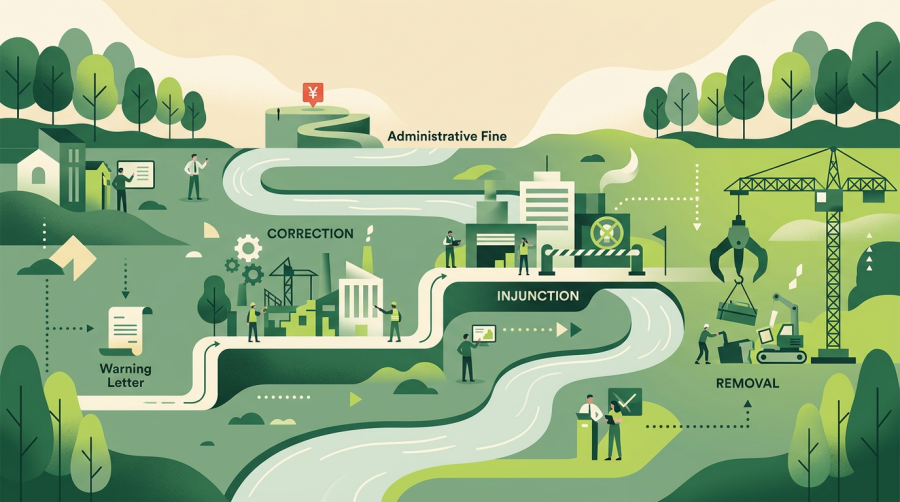
Note: This overview is general information and does not constitute legal advice; enforcement practice also varies between Member States. Where a complaint, a demand to stop a practice or a request from an authority is received, individual legal advice is advisable; national law may differ.
EmpCo chapter
Directive (EU) 2024/825 does not itself create legal claims against individual traders. Like the Unfair Commercial Practices Directive (UCPD), which it amends, it binds the Member States, and traders are bound by the national rules implementing them. Article 11 UCPD requires Member States to ensure that adequate and effective means exist to combat unfair commercial practices. Persons or organisations regarded under national law as having a legitimate interest in combating such practices, including competitors, must be able to take legal action and/or bring the practice before an administrative authority that is competent to decide on complaints or to initiate appropriate legal proceedings. Courts decide on the cases brought before them.
How this works in practice differs between Member States. Some rely mainly on court-based private enforcement by competitors and associations; others rely mainly on public consumer authorities; many combine both. Which person or organisation can take action in a specific case therefore depends on the national rules, the legal basis relied on, the infringement, the market concerned and the type of proceedings.
Article 11 UCPD expressly names competitors among those who may have a legitimate interest. A competitor may wish to challenge consumer communications that it considers unfair. This does not mean that every competitor is automatically entitled to bring an action: the conditions laid down by national law must be met. A trader should therefore have a specialist check who is making the allegation, which practice it relates to and what specific change is being demanded.
Depending on national law, trade associations and consumer organisations may also be treated as having a legitimate interest. In addition, under the Representative Actions Directive (Directive (EU) 2020/1828), qualified entities designated by the Member States can bring representative actions for injunctions and redress against infringements of the UCPD. Where national law grants standing, they can typically seek an order to stop an unfair commercial practice and to remove its effects. Consumer organisations and trade associations often work with their own assessment criteria and procedural requirements. In some Member States, a formal letter demanding that the practice be stopped is the usual first practical step; such a letter is not the same as a court order. Any response should take into account the legal status of the letter and the deadline it sets.
Consumers can report an advertisement, lodge a complaint or, under the conditions set by national law, have their own legal claims assessed. Article 11a UCPD requires Member States to give consumers harmed by unfair commercial practices access to proportionate and effective remedies. However, a single report does not in itself answer the question whether a practice is lawful. Competent authorities can open investigations or take measures within their remit. Where an infringement affects consumers in more than one Member State, national authorities cooperate under the Consumer Protection Cooperation Regulation, Regulation (EU) 2017/2394. Traders should therefore keep a clear record of the facts, versions and sources.
First, the version complained of should be captured. The publication date, target audience, product, source and any changes should then be documented. In addition to the current website, the team should also check advertisements, social media posts, product feeds and printed materials. A web scan can reveal current, publicly accessible repetitions of the same content. Internal archives and contractual documents must be reviewed in addition.
The EmpCo Manager provides possible findings and risk indicators. This helps with taking stock and with preparing a discussion with the relevant department or a law firm. The system does not decide whether a legal claim exists and is no substitute for legal advice.
When a demand letter or an enquiry from an authority arrives, the deadlines and the specific demands should be examined first. A hasty public response can narrow the facts of the case or create new statements. A coordinated approach is better: properly recorded evidence, a named person in charge and a specialist assessment. Correcting the claim and preparing the legal response can run in parallel, but not without coordination.
Responsibilities should be clearly allocated: marketing captures campaigns and variants; product or procurement provide technical and supplier documentation; and the legal department or external advisers assess the legal position, the deadline and the response. A central project lead records which version has already been corrected and which channels are still open. In this way, the trader avoids answering a complaint only on the home page while the same statement lives on in a feed.
In dealings with the person or organisation raising the complaint, a trader should only assert facts that it can substantiate. An internal assumption should not be presented as a public finding of fact. In response to consumer enquiries, a factual correction can be sensible, but it should be coordinated with the legal strategy. The documentation helps to distinguish between the current publication, the historical archive and a planned change.
The EmpCo Manager supports the technical search for occurrences on publicly accessible pages. It answers neither the question whether the person or organisation complaining has standing nor the question whether a formal undertaking to stop the practice should be given.
For the internal record, the date of receipt, the deadline, the version complained of, the contact person and the next decision are noted. This information helps to coordinate the timing of operational website changes and legal communication.
The file links this information to the final version and to the sources as they stood at the time.
In Germany, the rules have been implemented by the Third Act amending the Act against Unfair Competition (UWG), published in BGBl. 2026 I No. 43. Standing to claim an injunction and removal follows § 8 UWG: competitors and qualified trade and consumer associations can bring actions if the statutory conditions are met.
In practice, an Abmahnung (a formal warning letter, usually with a request to sign a cease-and-desist undertaking backed by a contractual penalty) is often the first step. It is not the same as a court injunction, but it sets short deadlines and should be assessed promptly with legal advice.
Note: Who can take action against advertising in a specific case depends on the applicable rules and should be assessed by a specialist or a lawyer. This article does not constitute legal advice; national law may differ.
EmpCo chapter
A fine under the turnover-based regime, with a maximum of at least 4% of annual turnover, is not an automatic consequence of every infringement of the EmpCo rules. The relevant EU provisions are Article 13(3) and (4) of the Unfair Commercial Practices Directive (UCPD). They apply where penalties are imposed in coordinated actions under Article 21 of Regulation (EU) 2017/2394, the Consumer Protection Cooperation (CPC) Regulation. Such coordinated actions concern a widespread infringement or a widespread infringement with a Union dimension within the meaning of that Regulation. For these cases, Member States must ensure that the maximum fine available is at least 4% of the trader’s annual turnover in the Member State or Member States concerned. As a directive binds Member States and not traders directly, the concrete conditions, maximum amounts and procedures follow from the national rules implementing the UCPD. A precise description is therefore more important than a blanket figure.
Article 13(3) UCPD does not set a fixed fine. It sets a floor for the maximum amount that national law must allow in coordinated actions: at least 4% of the trader’s annual turnover in the Member State or Member States concerned. Where information on annual turnover is not available, Article 13(4) UCPD requires that the maximum fine is at least EUR 2 million. Member States may provide for higher maximum amounts, and national law determines how the fine is calculated in the individual case. It follows that the statement ‘EmpCo always costs 4% of turnover’ is just as imprecise as the statement that a fixed lump sum is always at stake. Whether a fine is imposed and which calculation applies depends on the legal requirements and the proceedings.
The provision is not triggered by any single, isolated occurrence. The terms ‘widespread infringement’ and ‘widespread infringement with a Union dimension’ are defined in Article 3, points (3) and (4), of Regulation (EU) 2017/2394; in essence, they cover infringements that harm the collective interests of consumers in several Member States. In addition, the 4% rule applies only where the fine is imposed within a coordinated action of the competent national authorities under Article 21 of that Regulation. Outside such actions, Member States lay down their own penalties under Article 13(1) UCPD, which may also include fines. These requirements distinguish the turnover-based fine from a private demand letter or an individual claim for an injunction.
Traders should therefore not equate a risk indicator with the maximum fine. A finding points to a possible issue in the communication. It does not mean that the conditions for a turnover-based fine are met. The relevant department and, where necessary, a law firm should assess the facts, the reach and the procedural situation.
A claim register can record the wording, URL, product, publication date, sources and versions. For a central template, the register notes on how many pages and in which channels it was used. A scan of publicly accessible pages can supplement this overview. Offline material, internal systems and historical campaigns must be recorded separately.
The EmpCo Manager supports searching and prioritisation. It does not assert that a fine is due, does not calculate binding liability and does not replace a legal assessment. Its value lies in making findings visible early and traceable for internal work.
A single finding on a product page answers neither the question of how widespread an infringement is nor the question whether there is a coordinated action. Further legal requirements would have to be examined for that. Nor is the relevant turnover simply a figure from the financial report: it is part of the statutory calculation. Internal communication should therefore speak of a possible issue, not of an established turnover-based fine.
A report states the number of occurrences, the channels affected, the reused text source, outstanding evidence and planned dates. It can document the size of the company as organisational context, but should not derive an automatic sanction from it. Where a legal question remains open, it is marked as a decision point for the responsible specialist department or for legal counsel.
This separation helps to manage EmpCo risks realistically. It avoids both exaggerated fear of a blanket 4% consequence and false confidence where a broad campaign has been published without a sufficient basis.
Such a report should not suggest a ranking of legal sanctions. It describes the substantiated facts and marks which questions only the legal department or legal counsel can answer. This improves the quality of the internal decision.
The sources as they stood at the time, the date of the report and the underlying claim version are stated expressly, so that later enquiries can be answered on the same factual basis.
In Germany, the rules have been implemented by the Third Act amending the Act against Unfair Competition (UWG), published in BGBl. 2026 I No. 43. Under § 19(1) UWG as amended, a fine requires an intentional or negligent breach of § 5c(1) UWG, which covers widespread infringements and widespread infringements with a Union dimension within the meaning of Regulation (EU) 2017/2394. Under § 19(5) UWG, the administrative offence may only be penalised within a coordinated enforcement action under Article 21 of that Regulation.
The German maximum amounts depend on the size of the trader. For traders with an annual turnover of no more than EUR 1.25 million, § 19(2) UWG sets a maximum of EUR 50,000. For traders with a higher annual turnover, the maximum under § 19(3), first sentence, is 4% of the annual turnover achieved in the Member States affected by the infringement; where that turnover cannot be determined, the fine may be up to EUR 2 million under § 19(3), second sentence. Here too, the statement that a fine of EUR 50,000 is always at stake is as imprecise as a blanket 4%.
Note: This article explains the legal framework in general terms and does not constitute legal advice; national law may differ.
EmpCo chapter
An EmpCo check is first of all a decision framework: it links the scope of a statement, its factual basis, the relevant category and the necessary next step. This chapter explains which decision has to be taken at each stage. The practical sequence of steps is set out in Chapter 29; the data fields needed for it are described in Chapter 30.
The review inventory is not limited to explicitly ‘green’ words. Images, labels, product names, comparison filters and future targets can also convey an environmental message. The first decision is therefore whether the presentation suggests to consumers an environmental impact or improvement. If the answer is yes or remains open, the statement is included. If the communication is purely internal or clearly has no environmental reference, the reason for excluding it is briefly recorded.
Next, the team decides whether it is dealing with a single occurrence or with a reused original statement. The same sentence can travel from a product database into the shop, an advertisement and an online marketplace. In that case, any corrective action should target not just one URL but the common source of all these placements.
The team describes what is claimed and what it refers to. Is it a material, a component, a product, a product range, a company or a future target? Which stage of the life cycle is meant? A statement about recycled material is narrower than a general environmental promise. A target for one site is narrower than a target for the entire group.
The meaning that consumers can be expected to take away is compared with the data basis. If the claim appears broader, the team clarifies whether a visible qualification exists. It should be attached to the claim in the same medium and be easy to understand. A link that is hard to find does not automatically correct the first impression created by the headline claim.
First, the team distinguishes between a practice listed in Annex I to the Unfair Commercial Practices Directive (UCPD), the ‘blacklist’, which is prohibited in all circumstances, and a case-by-case assessment under the general rules on misleading actions and omissions (Articles 6 and 7 UCPD), as implemented in national law. A sustainability label (Annex I, point 2a), a generic environmental claim (point 4a), a product-related claim based on the offsetting of greenhouse gas emissions (point 4c) and presenting requirements imposed by law on all products within the relevant product category on the Union market as a distinctive feature of the trader’s offer (point 10a) are different categories. If none of them fits clearly, the statement can still be relevant because of its overall impression. The classification remains a working hypothesis until the facts and the legal question have been clarified.
The EmpCo Manager supports the search, grouping and prioritisation of findings. Its risk indicators and confidence levels are working information. They do not constitute a binding legal assessment and are no substitute for advice from a lawyer.
The source must cover the same product variant, the same period and the same characteristic as the advertising. If the evidence is narrower, the team does not try to hide the gap behind a general footnote. It chooses between a narrower wording, a clearly attached qualification, an updated basis, removing the statement or seeking individual advice. Keeping the statement unchanged is only a defensible decision if the statement, its context and the facts match.
Marketing describes the objective and tone. Product, procurement or sustainability provide the facts. The person or team responsible for approval assesses open questions. The decision framework assigns each open question to a responsible role: data gaps go to the specialist department, unclear advertising effects to editorial and design, difficult legal questions to the legal department or to legal counsel.
A good check does not end with a green status field. It records which source was checked, which assumption remained open and why the chosen wording is considered to have the right scope. Where an individual legal assessment is necessary, it is documented as a separate step. This keeps the automated preliminary review separate from the binding decision.
At the end, the editorial team receives either a substantiated version, a specific revision task or an escalation to the specialist department and advisers. These three outcomes are organisationally clearer than a blanket ‘passed’. The EmpCo Manager provides findings with page context, a risk indicator and a confidence level; responsibility for the task overview and for the professional decision remains with the company.
Each case ends in one of five decision categories: keep as documented, revise the substance, add a source, stop publication or obtain legal clarification. Chapter 29 translates these categories into a concrete sequence of steps; Chapter 30 sets out how they are stored with version and date.

Note: The EmpCo check is an organisational preliminary review and does not constitute legal advice; national law may differ.
EmpCo chapter
A systematic EmpCo check turns the decision logic from Chapter 28 into a concrete sequence of work. Each step has an input, an output and a handover to the next role. This keeps a case manageable even when the marketing, product, sustainability and legal teams work on it one after another.
At the outset, the person responsible sets out in writing which markets, languages, product lines and publication versions the run covers. This includes the website, online shop, product database, newsletters, social media, advertisements, online marketplaces, packaging, catalogues and sales material. A domain check covers publicly accessible content; closed systems and physical materials are covered by separate collection tasks. The result of this step is a clearly delimited list of channels, not a mere statement of intent.
The editorial team captures each occurrence with its URL or medium, a screenshot, the date, the wording, the visible design and the team responsible. For a video, this includes the spoken text, on-screen text and the description. For a label, the motif and its placement are recorded; the issuer and the criteria may initially be marked as open questions for the specialist teams. Work on the content begins only once the unaltered publication has been captured.
The team describes whether the claim relates to a material, a component, a product, a product range, the company or a future target. The environmental aspect, the time period, the basis of comparison and the system boundaries are added. A specific material share must not silently turn into an overall claim about the product. A target for one site must not sound like a target for the entire group.
The relevant specialist department receives a specific request setting out the claim, its subject, the time period and the missing fact. Technical data, calculations, certificates, supplier declarations and target plans are assigned to the occurrence. The possible EmpCo category initially remains a working hypothesis. If an answer is missing, the case stays open with a named owner and a deadline; it is not closed on the basis of an assumed source.
The EmpCo Manager helps to locate publicly accessible occurrences and sorts possible issues as findings. Risk indicators and confidence levels help to prioritise them. They do not constitute a binding legal assessment.
The approval function receives the captured version, the comparison with the sources and the open questions. It then chooses one of the following options: documenting the claim unchanged, making it more specific, adding a specification, updating the source, removing the content or obtaining individual advice. The decision is stored with the date, version, reasoning and person responsible. Where several channels are affected, the central original version is marked and a specific change request is given to the editorial team that implements it.
After publication, another person or the responsible editorial team opens the affected pages and also searches for the old wording. The product data feed, newsletter, online marketplace, translations and public archive are checked in line with the defined scope. The result is not simply ‘done’; it names the channels checked, the remaining occurrences and the next review date.
Not every occurrence has to be dealt with on the same day. A team can start with prominent generic environmental claims, its own sustainability labels, climate claims and future targets. Precise information on materials, claims about repair and software updates, and older archive pages follow. This order is an operational prioritisation; it does not mean that an occurrence dealt with later is unproblematic.
Marketing documents the wording and the channels in which it is published. Product, procurement or sustainability teams provide the facts. An approval function assesses the open questions. Where an agency creates variants, the master text and the adaptations are recorded together. This preserves the link between the source and the published version.
After every major text change, the team does not just open the new URL. It also searches for old wording, synonyms, translations and image motifs. A repeat scan with the EmpCo Manager can prepare this comparison for publicly accessible pages. Internal data feeds, print material and closed campaign archives remain additional tasks.
At the end of each check run, the responsible function receives a list of open sources, prioritised occurrences, specific text tasks and a date for the follow-up check. A status such as ‘open pending specialist input’ is more helpful than a seemingly final result when product data or external verification is still missing. The handover is linked to the scan version and the publication version.
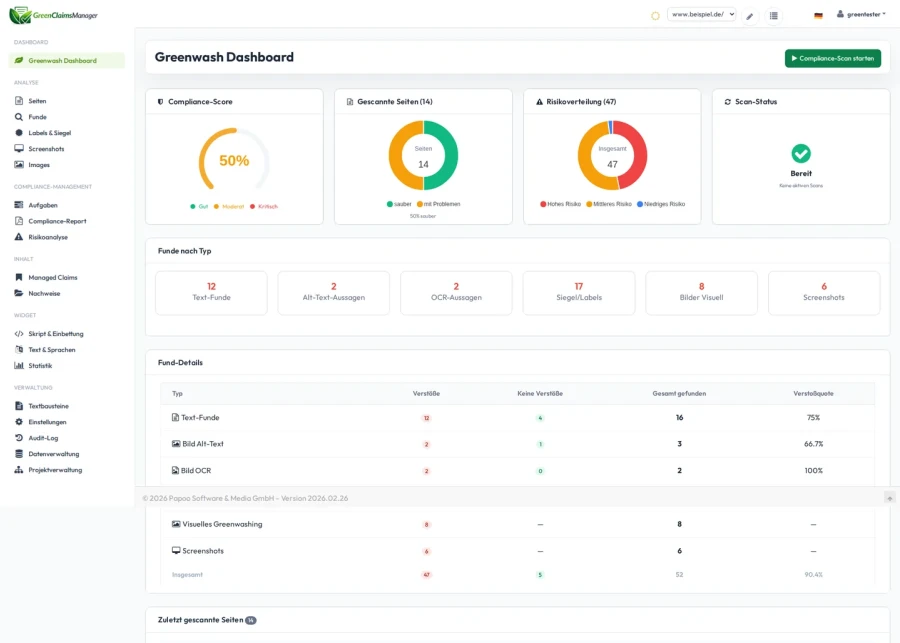
Note: A systematic check is an organisational preliminary review and does not constitute legal advice; national law may differ.
EmpCo chapter
Good EmpCo documentation needs a traceable data model. Unlike Chapter 28, which structures decisions, and Chapter 29, which describes the workflow, this chapter deals with the records and their relationships. Publication, claim, subject of the claim, source, decision and version must not be merged into a single free-text field.
The claim record contains a stable identifier, the exact wording or visual signal, the environmental aspect, the subject of the claim, the reference unit, the time period and any basis of comparison. Product variant and market are not just mentioned in running text but held in separate fields. This allows the same claim to be linked to several publications without having to create it afresh for each URL.
A publication links the claim to a URL or medium, language, target audience, publication date, screenshot and visible context. For an image, the motif, the embedded text and the alt text are added. For a label, its placement and presentation are recorded. This separation reflects the fact that the same original text can have a different effect on a product page, in an advertisement and on an online marketplace.
The source is not stored merely as a link. It is given a document type, issuer, date, period of validity and scope. A separate assignment describes which specific characteristic it supports for which claim and where its limits lie. A supplier declaration about fibres does not automatically substantiate the environmental impact of the whole garment. A certificate for one component does not necessarily apply to all product variants. This relationship belongs in an evidence comment, not in a blanket status such as ‘source available’.
The decision may read: documented unchanged, made more specific, amended, removed or referred for individual legal assessment. It refers to the exact claim version reviewed, the sources relied on and the visible publications. Date, person responsible, reasoning and next review date are separate fields. Where a claim is adjusted, the old version is retained and linked to the new version through a predecessor relationship.
A status column should not suggest that an automated finding has legally ‘passed’. Statuses such as ‘occurrence recorded’, ‘source open’, ‘confirmed by specialists’, ‘revision commissioned’ or ‘legally clarified’ are more useful. The EmpCo Manager delivers findings with page context, risk indicator and confidence level. The company incorporates them into its own workflow; the EmpCo Manager does not give binding approval.
Sources can expire, change or acquire a different scope. Each piece of evidence is therefore given a review or expiry date where one exists. For new product variants, the team checks whether the old evidence may be carried over. A company also documents who last reviewed the source.
A central claim may appear on the website, in the shop, in the newsletter, on an online marketplace and in printed material. The documentation links these occurrences to the original version. After publication, the team checks whether the old wording is still accessible. Versioning also helps in the event of enforcement action or enquiries, because the state of the content at the relevant time remains reproducible.
For a lean register, the following fields are sufficient to begin with: claim ID, version number, wording, publication ID, subject of the claim, environmental aspect, source ID, relationship note, decision status, person responsible and next review date. A claim may have several publications and several sources; conversely, one source may support several narrowly defined claims. These relationships must be stored explicitly. When something changes, the old version is not overwritten but linked to the new one.
A document can support several claims, but not every claim needs the same reasoning. Each assignment is therefore given a short explanation. A test report on the share of a substance describes a different characteristic from a plan for the future. A certification may cover only certain products, sites or periods. These limits are made visible in the register.
The teams responsible should know who may change a record and who confirms approval. When a source is replaced, the review date is updated. For a new product, the old record is not simply copied. The EmpCo Manager structures findings, page context, risk indicators and confidence levels; the people responsible organise tasks, documents and specialist decisions in the downstream process.
A change log records the old and new wording, the reason, the source, the product scope and the approval date. Where a central template is used, the affected channels are added. This makes it possible to check after publication whether the change has reached every channel. In the event of a legal enquiry, the company can reproduce the version used at the time without confusing the current version with the historical one.
In Germany, the rules have been implemented by the Third Act amending the Act against Unfair Competition (UWG), published in BGBl. 2026 I No. 43. The explanatory memorandum is contained in Bundestag printed paper 21/1855 (BT-Drs. 21/1855). A reproducible version history is particularly useful in Germany when a company receives a warning letter (Abmahnung).
Note: Documentation supports internal decisions and does not constitute legal advice; national law may differ.
EmpCo chapter
EmpCo, the national rules implementing it, the CSRD and the so-called Green Claims Directive should not be lumped together as a single set of rules. They pursue different purposes and have different legal status. EmpCo is the short name for Directive (EU) 2024/825, which amends the Unfair Commercial Practices Directive (UCPD, Directive 2005/29/EC) and the Consumer Rights Directive (Directive 2011/83/EU). As a directive, it binds the Member States, not traders directly; traders are bound by the national rules implementing it (in Germany: the UWG). The CSRD concerns sustainability reporting. The Green Claims Directive is the Commission proposal COM(2023) 166 final for a separate directive on explicit environmental claims. Such a directive is not in force and is therefore not an applicable standard for an EmpCo assessment.
EmpCo describes the European amendment to consumer law. The national unfair commercial practices law of each Member State contains the provisions through which these requirements are applied there. In Member States that have transposed on time, those provisions have applied since 27 September 2026 (Article 4(1) of the Directive); where a Member State has transposed late, the national position there should be checked. For a specific advertisement, both levels have to be read together and applied to the facts of the case. The Directive explains the objective and structure; the national implementing provisions provide the binding point of reference for the trader. Their wording and their enforcement may differ between Member States.
The Green Claims Directive is often mentioned together with EmpCo because both concern environmental communication. They are not identical, however. For the EmpCo Manager, the Green Claims Directive is not an applicable assessment standard. A text should not present it as if a uniform additional certification procedure were already in force. Where its political development is mentioned, its status must be clearly indicated.
The CSRD governs sustainability reporting by certain undertakings. It asks for reporting information and company data, not for each individual advertising claim. Reporting data can be a source for internal communication. However, they do not replace checking whether a specific claim relates to the same product, the same period and the same system boundaries.
The EU Taxonomy is a classification and reporting framework for certain economic activities and financial market disclosures. It is not a general benchmark for every consumer advertisement. Sector-specific rules, labelling law, product standards and contractual requirements may also be relevant. A company should record these levels separately rather than deriving an advertising claim directly from a reporting obligation.
The EmpCo Manager bases its preliminary review on patterns relevant under the EmpCo rules. Its findings and risk indicators point to possible issues. They do not provide a binding statement on CSRD reporting obligations or on Taxonomy classification.
First, the team clarifies which set of rules actually applies to the specific facts. Second, it checks whether the information is published as a report, as product information or as advertising. Third, it compares the source with the product, period, target audience and system boundaries. This prevents a figure taken from a report from automatically being presented as a comprehensive consumer claim.
A company may have a CSRD report full of data and still face an unresolved question about a claim on a product page. Conversely, a small piece of product information may be precisely substantiated without describing the company’s overall performance. Separate registers show which information is already available and which reuse of that information in a claim still needs to be assessed by specialists.
When the report, product or campaign changes, the link is checked again. The EmpCo Manager can show and prioritise the public finding. It does not decide which set of rules an organisation has to comply with overall.
The briefing records whether a text is general consumer information, product advertising or reporting communication. The matching list of sources is then chosen. A blog post about the CSRD can explain the differences, but it should not be worded as if every reporting obligation were also an EmpCo prohibition. A product text may cite reporting data, but it must disclose their scope.
In the editorial process, the primary source, national implementation, reporting data and supplementary sector information are filed separately. This makes it possible to see later whether a statement rests on applicable law, a company metric or an editorial assessment. This structure makes updates easier without mixing up the different regulatory purposes.
In Germany, the rules have been implemented by the Third Act amending the Act against Unfair Competition (UWG), published in BGBl. 2026 I No. 43. The explanatory memorandum is contained in Bundestag printed paper 21/1855 (BT-Drs. 21/1855). For advertising aimed at consumers in Germany, the UWG is therefore the national point of reference, read together with Directive (EU) 2024/825.

Note: This comparison is for orientation only and does not constitute advice on any individual set of rules; national law may differ.
EmpCo chapter
EmpCo and the Green Claims Directive are often mentioned together because both are linked to environmental communication. They are, however, separate EU initiatives. EmpCo is based on Directive (EU) 2024/825, which amends the UCPD (Directive 2005/29/EC) and the Consumer Rights Directive (Directive 2011/83/EU). As a directive, it binds the Member States, which had to transpose it by 27 March 2026 (Article 4(1)). Where a Member State has transposed on time, its national provisions have applied since 27 September 2026; where it has transposed late, the national position there should be checked. The Green Claims Directive refers to the separate Commission proposal COM(2023) 166 final on explicit environmental claims. The proposal is not a directive that has entered into force and is not an applicable assessment standard for the EmpCo Manager.
EmpCo supplements the rules on unfair commercial practices and consumer rights. Its focus includes generic environmental claims, sustainability labels, future targets, product-related climate claims, statutory minimum requirements presented as a distinctive feature, and claims about durability, software updates and reparability. At EU level, it does so by amending Articles 2, 6 and 7 UCPD, by adding new practices to Annex I UCPD (the ‘blacklist’) and by amending the Consumer Rights Directive (Directive 2011/83/EU), mainly as regards information on durability, reparability and software updates; Member States implement these changes in their national law.
The rules apply in the specific context of communication with consumers. A company therefore examines the claim, product, target audience, medium and source. EmpCo is not a general label for ‘good’ companies, nor is it a complete certification process.
The Green Claims Directive must not be described as an additional obligation, already in force, to have every environmental claim certified in advance. Political initiatives, drafts and debates can change. Where a specialist text mentions its development, it must state the status as at the date of publication. For the operational EmpCo inventory, what counts is the applicable EU legal framework and the national rules implementing it.
A company should therefore keep its source lists separate. The primary source for EmpCo is Directive (EU) 2024/825. For each Member State, the national implementing act and, where available, its official explanatory materials are added (see ‘In Germany’ below for an example). A source relating to another legislative initiative must not be used tacitly as evidence of an applicable EmpCo requirement.
The EmpCo Manager can pre-sort findings according to patterns relevant under the EmpCo rules. It does not claim to apply a Green Claims Directive and does not provide certification. The output shows possible claims, page reference, risk indicator and confidence level for internal review. The company adds the sources and product facts.
A specialist article cites the primary text and states its date of last review. If the status of a legislative initiative changes, the distinction is updated. A draft, a political position or a press release must not be described as an applicable obligation without being put into context. At national level, the Directive, the implementing act and, where available, its official explanatory materials remain the key references.
A team first checks the applicable EmpCo requirements as implemented in national law. Only then can it add political developments as further context. The internal task list should therefore distinguish between ‘applicable rule’, ‘open interpretation’ and ‘possible future change’. This separation prevents a product text from being justified by requirements that do not currently apply.
The EmpCo Manager’s preliminary review remains focused on the applicable legal framework. Risk indicators help with the review, but the tool does not replace a source or up-to-date data.
An editorial page states the date of the legal position presented and links to the primary sources. If the political environment changes, the status note, the description of sources and, where necessary, the product text are updated. Such maintenance is quite different from claiming that a future initiative already applies.
A company can follow the development of a separate initiative, but it should handle its current communication under the applicable EmpCo framework as implemented in national law. If the law changes later, sources, date of last review and affected claims are updated together. Until then, the product description is limited to the functions actually supported.
In Germany, the rules have been implemented by the Third Act amending the Act against Unfair Competition (UWG), published in BGBl. 2026 I No. 43. The official explanatory memorandum is contained in Bundestag printed paper 21/1855 (BT-Drs. 21/1855). The German implementation consists of amendments to the UWG and to its Annex, which contains the national blacklist. Together with the Directive, the amending act and the explanatory memorandum are the central references for communication in Germany.
Note: The legal status of a future legislative initiative may change; please check the current position. National law may differ.
EmpCo chapter
EmpCo, unfair commercial practices law and the CSRD answer different questions. EmpCo is Directive (EU) 2024/825, which aims to protect consumers against misleading environmental and sustainability information. It amends the UCPD (Directive 2005/29/EC), the EU framework for unfair commercial practices. Because a directive binds the Member States rather than traders directly, the relevant EmpCo requirements reach traders through the national rules implementing the UCPD (in Germany: the UWG). The CSRD concerns sustainability reporting and pursues a different regulatory purpose.
EmpCo and the national rules implementing the UCPD are relevant to consumer communication and commercial practices. The CSRD is aimed at reporting by certain undertakings and at the users of those reports. A sustainability report may be publicly accessible and may therefore also be read by consumers. Its purpose and data structure are nevertheless not the same as those of product advertising.
An advertising claim often describes a benefit, a target or a product characteristic. A CSRD report may contain metrics, risks, strategies, governance and progress. These data may be relevant to advertising, but they have to be applied to the specific product, period, system boundaries and target audience. A reported value is not automatically a finished advertising claim.
When a company uses a reported figure in marketing, it documents the source, the calculation, the subject of the claim and how current the figure is. It checks whether the claim makes more of the figure than the figure actually says. A value for one site does not become a group value without explanation. A corporate target does not automatically become a product characteristic. External assurance of the report does not replace the assessment of the advertising.
The EmpCo Manager can find public claims and prepare them as findings with risk indicators. It does not automatically analyse CSRD reports or financial data, and it confirms neither the completeness nor the accuracy of the underlying metric. The responsible sustainability, finance and legal teams must add this information.
For a group structure, the team also notes whether the value is consolidated or relates to a single site. For product data, the variant and market are recorded. This information helps to ensure that reporting information is not transferred unnoticed to a different scope.
When reporting hands over to marketing, the report version, data cut-off date, subject of the claim and permitted wording are recorded. This lets the editorial team see which statement from the report may be used and which extension needs an additional check.
This handover is repeated for each new reporting period.
‘According to the report, our emissions have fallen’ is initially information about a reported value. ‘Our product is therefore climate-friendly’ extends the statement to a product and can raise further questions. The editorial team should disclose this transfer or keep to the narrower reported fact. This distinction does not make the text weaker; it makes it easier to follow.
The sustainability team often knows the methodology and how current the data are. Finance or the reporting function is responsible for the report. Marketing designs the public claim. Legal or an external specialist assesses difficult individual cases. A shared claims register connects these roles without mixing up their different tasks.
When a reported value is updated, the editorial team reviews all claims derived from it. Conversely, a new product campaign may need a source that the report never provided for. The EmpCo Manager helps to collect public findings. It makes no statement on whether a report is complete or whether a metric is factually correct.
Each reuse of a reported figure documents the report version, the calculation, the product or corporate scope and the publication date. A figure without this information is hard for later teams to interpret. The reference unit is therefore recorded in the claim itself or in a visibly associated explanation.
In Germany, the rules have been implemented by the Third Act amending the Act against Unfair Competition (UWG), published in BGBl. 2026 I No. 43. The explanatory memorandum is contained in Bundestag printed paper 21/1855 (BT-Drs. 21/1855). The distinction described above between advertising claims and CSRD reporting applies there in the same way.
Note: Assessing an advertising claim and assessing a report may require different specialist reviews; national law may differ.
EmpCo chapter
The EmpCo Manager supports companies in the practical preliminary review of their publicly accessible environmental and sustainability communication. Its functions form a clear chain: capturing the website, analysing text, image and label signals, presenting possible findings with page reference, and providing a risk indicator and confidence level for the review. The result helps teams to sort extensive websites and creates a common working basis for marketing, sustainability and specialist advisers.
An analysis starts with a publicly accessible website. The EmpCo Manager follows the accessible pages and collects possible environmental claims, visual cues and labels. Each finding remains linked to its URL and context. This allows teams to see whether a wording is used once or in several places. Recurring standard text blocks can be grouped for further work.
The analysis is a preliminary review. The EmpCo Manager does not automatically know internal contracts, supplier data, product variants, closed newsletters, printed packaging or the full logic of a platform. The company therefore supplements the results by comparing them with its sources and assessing them in substance.
Risk indicators and confidence levels help to order the list of findings to be reviewed. A generic environmental claim on a heavily visited home page can be handled earlier than a precise technical statement in a specialist document. This prioritisation is an organisational decision, not a binding judgement on whether a finding is lawful.
The EmpCo Manager can also be used when content is republished. After a change, teams check whether the old wording is still publicly accessible. When a product changes or a new source becomes available, a new analysis or a targeted follow-up check is planned.
The specialist department receives possible environmental claims with page reference and can add the subject of the claim, the source, the period and the context. It is then decided whether the text is made more specific, the specification is made more visible, the evidence is updated or an individual legal review is obtained. The EmpCo Manager does not document this decision as legal approval.
A project can run analysis, specialist review and follow-up check as separate work steps. Marketing works on text and design. Sustainability or product teams provide sources. An approval function decides on open questions of fact. The finding remains the common reference point, even when several people work on it.
The product output comprises possible findings with page reference and context, together with a risk indicator and confidence level. This information is neither evidence management nor legal approval. Outside the automated analysis, the team can add the product variant, source, period and next action. Chapter 35 explains the actual output types; Chapter 36 sets out the limits of what each type can show.
The first analysis is not an end point. After a change, the team checks whether the old wording remains on other pages, in data feeds or in language versions. For a new product or an amended source, the finding is assessed again. The EmpCo Manager supports the search, not binding approval.
In the subsequent work process, a finding can be given a next step. The team may request a source, clarify the product scope, change the wording, add a specification or obtain advice. The result is a workable task list, without implying that the product offers a task management function or takes legal decisions.
A team can sort findings by breadth of the claim, visibility, reuse and open sources. These criteria are documented in the project so that the order remains traceable. The EmpCo Manager provides structured indications for this; it replaces neither the establishment of the facts nor the final specialist decision.
The status of the specialist review is documented in the relevant workflow.
After the specialist review, the status of the finding is updated and the source used is recorded. Where the text changes, a new search for the old version follows. This shows whether the analysis has resulted in a completed text task, an open data question or a need for advice.
Note: The EmpCo Manager provides findings, risk indicators and confidence levels, not legal advice or binding approval; national law may differ.
EmpCo chapter
The EmpCo Manager analyses publicly accessible web pages for signals that may be relevant to environmental and sustainability communication. The structure below deliberately covers only the documented output types: the finding, the page reference and context, and the risk indicator and confidence level. Facts, sources, tasks and specialist decisions are not automatically generated output types; the company adds them in its subsequent work process.
A finding is the detected section of a publicly accessible page that may be relevant for further review. It can be a wording, an image motif, a label, a symbol or a combination of these. Generic environmental claims, future targets, comparisons and references to recycling, climate impact, repair or software updates are possible types of signal. A finding is initially an observation, not a statement that the elements of a legal provision are met.
Environmental communication can arise without any explanatory sentence. Leaf or climate symbols, green product markings, nature motifs and a company’s own labels can influence the overall impression. The EmpCo Manager can flag such signals for further review. The analysis does not establish what meaning an image conveys in the individual case. The team therefore examines the motif, its placement and its connection to the text.
For labels, the EmpCo Manager can show a finding. It cannot, however, infer from the image alone who awarded the label, which criteria apply or whether a certificate is current. This information must be added from the company’s documents and the visible explanation.
Because of the heading, price, image and table around it, a claim on a product detail page may have a different effect from the same sentence in a specialist article. The page reference links the finding to the publicly accessible page; the context helps to locate the excerpt in the published presentation. This does not yet amount to a complete assessment of the target audience, product variant or overall impression. Mobile versions, advertisements, platform fields and offline material remain additional areas of work.
A risk indicator helps to prioritise the review. It is not a judgement on lawfulness, liability or sanctions, and it does not confirm that all the elements of a legal provision are met. It is best used to open the most prominent findings first and then to establish the missing facts. The EmpCo Manager is not a legal adviser and does not replace a case-by-case review by a lawyer.
The confidence level describes how certain the analysis system is that it has recognised a stored pattern. High confidence does not mean a high probability of an infringement. Equally, low confidence does not make a claim legally unobjectionable. The confidence level and the risk indicator therefore answer different questions and must not be combined into a supposed legal score in reports.
Once a finding has been flagged, the team opens the published page and reads it as it is actually presented. It checks the heading, image, product data, footnote, mobile view and links. Internal facts are then added: supplier, certificate, calculation, target plan or software update commitment. Only this combination makes a sound decision on revision or further advice possible.
A finding can also be valuable precisely because it reveals a missing source. In that case, the team does not automatically flag an infringement but an open evidence question. For a label, the issuer is sought. For a recycling claim, the reference unit is clarified. For a future target, the plan is requested. The work status remains traceable until the question has been answered.
The EmpCo Manager analyses publicly accessible web pages. Printed material, closed systems, internal briefings and platform fields that are not visible are checked separately. Detecting an image does not automatically tell the team what meaning all readers attach to it. The analysis speeds up the search; it does not replace specialist and legal assessment.
After the review, the team links each relevant finding to the appropriate document. For a text signal, this may be a product data sheet; for an image signal, a certificate; for a claim about future environmental performance, a published implementation plan (see Article 6(2), point (d), UCPD). If no suitable source exists, the gap is documented as a task. This keeps the analysis distinguishable from the subsequent decision.
After a text change, the team can search again and compare the old finding with the new version. This shows whether the claim has been adapted only at one URL or also in templates, translations and platform variants. The follow-up check documents the status; it does not automatically confirm lawfulness.
The current status of the sources is recorded at the same time.
Note: The analysis provides indications for internal review and does not constitute legal advice; national law may differ.
EmpCo chapter
The EmpCo Manager can search publicly accessible websites for possible environmental and sustainability findings, structure signals and help teams set priorities. For each output type described in Chapter 35, this chapter shows where its informative value ends. The EmpCo Manager provides a documentation basis for internal work, but no binding legal assessment, no guarantee of completeness and no substitute for advice from a lawyer.
| Output type | What it does | What it does not prove | What needs to be added |
|---|---|---|---|
| Finding | marks a relevant section | the complete facts or an infringement | open the published page, identify the product and the scope of the claim |
| Page reference and context | makes the public page easy to locate | all language, mobile, platform or offline variants | record further channels and variants separately |
| Risk indicator | supports prioritisation | lawfulness, liability or penalties | have specialists review the elements of the legal provision and the facts |
| Confidence level | describes how reliably a pattern was recognised | the probability of an infringement | read it independently of the risk indicator |
These limits apply at the same time. A clearly recognised, high-priority finding may turn out, on specialist review, to be explained by a suitable source; a less clearly recognised finding may still contain a significant open question after review.
The results can be converted into a list for specialist review. Marketing handles wording and layout. Product, procurement or sustainability teams add facts and sources. An approval function decides on open questions. The scan shortens the search, but not the specialist decision.
The EmpCo Manager does not automatically know internal contracts, supplier declarations, technical calculations, the scope of certificates, closed newsletters, printed packaging, sales conversations or the complete logic of a platform. A publicly visible claim may therefore be only part of the facts. The company adds the facts that are not visible and checks whether the source concerns the same product variant, the same period and the same scope.
Visual signals also depend on context. A green symbol may be decorative, or, together with a headline and a label, it may create a broad expectation. The EmpCo Manager can flag the motif. The responsible team assesses its meaning within the specific overall impression.
The confidence level describes how reliably an analysis feature was recognised. It is not the probability of an infringement. A risk indicator shows a need for prioritisation, not a verdict. Internal reports should explain both terms separately so that technical indications do not turn into supposed legal decisions. Likewise, the number of findings must not be presented as the number of confirmed infringements.
After the scan, the claim, the subject of the claim, the source, the period, the design and the target audience are added. The team can word the claim more narrowly, make a specification visible, update the evidence, remove the content or obtain individual legal advice. After publication, a new search for old variants is carried out.
The review has three levels. First, the technical finding is clarified, that is, which signal was found on which page. Next comes the specialist assessment of the product concerned, the source and the period. Only then is it decided whether the claim is amended, kept, removed or referred for advice. The EmpCo Manager mainly supports the first level and parts of task organisation. It does not take over specialist or legal responsibility.
If the EmpCo Manager finds a recycling claim, it does not automatically know the actual material content or the infrastructure to which ‘recyclable’ refers. If it finds a claim about future environmental performance, it does not automatically know the implementation plan or the resources behind it (see Article 6(2), point (d), UCPD). If it detects a label, the body that awards it may need to be checked internally. In every case, technical and organisational documents are added.
The specialist review can work with a short task card: open the finding, enter the subject of the claim, link the source, check the design, decide on the next action. The status is saved with the date and the person responsible. This organisation takes place within the company’s own work process; it is not presented as a product function that is automatically available.
After the specialist review, the status of the finding is updated and the source used is recorded. If the text is changed, a new search for the old version follows. This shows whether the scan has led to a completed text task, an open data question or a need for advice. The scan version is linked to the publication version.

Note: The EmpCo Manager supports internal preliminary review and does not constitute legal advice; national law may differ.
EmpCo chapter
The most frequent questions about EmpCo concern the application date, greenwashing, evidence, labels, offsetting, social media and the official sources at EU and national level. Because a directive binds the Member States and traders are bound by the national law implementing it, the official sources include each Member State’s implementing act as well as the Directive itself. The answers must distinguish between general information and an individual legal assessment. EmpCo does not prohibit every environmental word. What matters are the specific claim, its context, the product, the target audience and the underlying basis.
No. Since 27 September 2026, the national provisions implementing Directive (EU) 2024/825 have applied in the Member States (Article 4(1)); where a Member State has transposed late, the national position there should be checked. ‘Greenwashing’, however, is not a single offence with a blanket yes-or-no formula. The new rules cover specific commercial practices, in particular those added to Annex I UCPD (the ‘blacklist’); in addition, the general prohibitions of misleading actions and omissions in Articles 6 and 7 UCPD continue to apply. A precise claim about material, energy consumption or a target may be permissible if its scope and the underlying data match.
Environmental claims need a suitable factual basis. The type of supporting document depends on the claim. A technical statement about material requires different data from a broad climate claim or a future target. ‘Scientific’ is no substitute for the question of whether source, product, period and reference unit match.
A link can provide additional details. It does not, however, automatically neutralise the effect of a prominent general claim. The specification should be understandable, visible and clearly connected to the claim. In short advertisements and on packaging, the core claim often has to be worded more narrowly in the first place.
Environmental labels are not abolished across the board. What matters is whether the label is based on a certification scheme or established by public authorities (Annex I, point 2a, UCPD), as well as the issuer, the criteria, the scope and the presentation. A company’s own logo can create the impression of independent confirmation. The specific assessment depends on the label and its context.
No. Factual information about a climate protection project is not automatically the same as a product-related claim that the product has no harmful effect on the climate. Claims that a product has a neutral, reduced or positive impact on the environment in terms of greenhouse gas emissions based on the offsetting of greenhouse gas emissions are prohibited in all circumstances (Annex I, point 4c, UCPD). For ‘climate neutral’, a distinction must therefore be made between reduction and offsetting. The scope of the communication must match the calculation.
Companies should take stock of ongoing consumer communication; as the national rules have applied since 27 September 2026, any inventory not completed before that date should be carried out now. The creation date alone does not answer whether a page, a data feed or a reused campaign continues to have an effect. An inventory with version, occurrence and source is the better starting point.
The decisive factor is not the channel but the commercial communication directed at consumers. Social media posts, content from advertising partners and advertisements can combine text, image, label and link. The version actually published should be saved and assessed.
The EmpCo Manager captures publicly accessible pages and structures possible findings. It provides risk indicators and confidence levels for internal review. It does not automatically know internal evidence and does not replace legal advice.
The answer depends on the claim, the medium and the applicable rule. Internally, the basis should be documented in a traceable way. Publicly, the information must be accessible in such a way that the scope of the claim is not extended in a misleading way. An internal source folder does not automatically replace a visible specification where one is required.
Not automatically. Certificates can relate to a material, a variant, a site, a production step or a period. The register records the scope. A brand claim must not go further than the certification and the other documents support.
The right review interval depends on publication frequency, product changes, the validity period of sources and the breadth of the claim. A new review is particularly useful after major publications, new suppliers, changed target plans or expired certificates. The EmpCo Manager can collect publicly visible variants again.
The team documents the open question of fact, records the occurrence and assigns a person responsible. The claim can then be worded more narrowly, the source can be added or individual legal advice can be obtained. A risk indicator is not published as a finished legal verdict.
In Germany, the rules have been implemented by the Third Act amending the Act against Unfair Competition (UWG), published in BGBl. 2026 I No. 43. The explanatory memorandum is contained in Bundestag printed paper 21/1855 (BT-Drs. 21/1855).
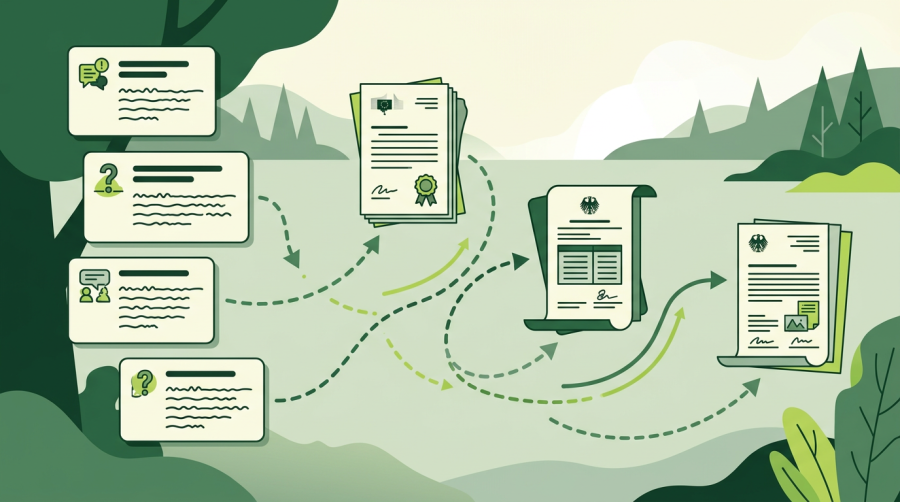
Note: The FAQ answers are general information and do not constitute legal advice; national law may differ.
EmpCo chapter
No. Directive (EU) 2024/825 binds the Member States, not traders directly; traders are bound by the national rules implementing it, which have applied since 27 September 2026 (Article 4(1)); where a Member State has transposed late, the national position there should be checked. ‘Greenwashing’, however, is not covered by a single blanket prohibition. The rules cover specific commercial practices listed in Annex I UCPD (the ‘blacklist’) and supplement the general provisions against misleading actions and omissions in Articles 6 and 7 UCPD. The decisive factor remains the specific claim in the specific consumer and product context.
The application date marks the point from which the national implementing provisions apply. It does not mean that all environmental communication disappears. Companies can share specific information about material, energy, repair or targets if the claim is factually accurate and its scope remains traceable.
Particular attention should be paid to generic environmental claims (Annex I, point 4a, UCPD), sustainability labels (point 2a), product-related climate claims based on offsetting (point 4c), legal requirements presented as a distinctive feature (point 10a), claims about software updates, durability, repair and consumables (points 23d to 23j) and claims about future environmental performance (Article 6(2), point (d), UCPD). Each group of cases has its own conditions. A vague ‘green’ is not the same as a specific recycled content figure.
A review asks what expectation the text, image, colour, product name and label create together; Article 6(1) UCPD expressly includes the overall presentation. A large general claim can broaden the scope of a technical statement. A footnote only helps if it is visible and understandably connected to the claim. A link to a separate report does not automatically correct the impression created by the headline claim of an advertisement.
Companies take stock of their current websites, online shops, social media, advertisements, packaging and platform listings. The EmpCo Manager can collect and prioritise public findings. Teams then add product facts, supplier data, certificates and target plans. Possible next steps are making the claim more specific, updating sources, removing the content or obtaining individual legal advice.
‘Our bottle is environmentally friendly’ is a generic claim. ‘The bottle is made of 70% recycled PET, based on the weight of the bottle’ is a narrower statement about material. The second claim also needs a suitable source and must match the specific variant. The difference shows why the assessment looks at scope and evidence, not at the environmental word alone.
A company’s own label next to either claim can broaden the overall impression. A future date can trigger additional requirements (Article 6(2), point (d), UCPD). Factual information about a climate protection project, in turn, must be distinguished from a product-related offsetting claim (Annex I, point 4c, UCPD). Each occurrence is therefore documented individually.
A company should take the application date into account in project planning and approvals without presenting it as a blanket ban on advertising. A date of last review, primary sources and clear limitations make the editorial text more robust. Where specific doubts arise, individual advice is the right next step.
For each finding, the claim, the subject of the claim, the visible context, the source and the status are recorded. A team can word the claim more narrowly, make a specification visible or pass on a legal question. The reasons are recorded with the version, so that later editorial teams understand why a wording was changed.
The person responsible records which facts support the claim and whether the visible context changes its scope. Where facts are still missing, the claim is not treated as finally assessed but is given a next step. This can be a check of the sources, a change to the text or individual advice. After publication, a new scan checks whether old versions are still accessible.
An internal log also names the product variant, the publication date and the source used. Where a claim is reused, newsletters, platform feeds and translations are linked. The editorial team can thus tell whether a single page has to be changed or a central template has to be adapted. The review remains tied to the specific facts and does not derive a blanket penalty from a single finding.
The current status of the sources is recorded at the same time.
In Germany, the rules have been implemented by the Third Act amending the Act against Unfair Competition (UWG), published in BGBl. 2026 I No. 43. The new German provisions have applied since 27 September 2026. The explanatory memorandum is contained in Bundestag printed paper 21/1855 (BT-Drs. 21/1855).
Note: Whether a specific advertisement is misleading can only be assessed on the basis of its full context; national law may differ.
EmpCo chapter
Companies should take stock of their existing consumer communication and assess it against the new rules. The national provisions implementing Directive (EU) 2024/825 have applied since 27 September 2026 (Article 4(1)); any inventory not completed before that date should therefore be carried out now. Where a Member State has transposed late, the national position there should be checked. No general, automatic obligation to change every older advertisement, regardless of its visibility, can be derived from the rules. Equally, the creation date is no blanket exemption. The decisive factors are continued publication, updating, reuse, the claim and its context.
Existing content includes product pages, category pages, blogs, newsletters, social media profiles, advertisements, marketplace listings, packaging, catalogues and sales aids. An old claim can live on in a central product feed, a translation or a campaign template. The inventory records the occurrence, version, date, the subject of the claim and the source.
First, prominent generic environmental claims (Annex I, point 4a, UCPD), a company’s own sustainability labels (point 2a), climate claims, in particular those based on the offsetting of greenhouse gas emissions (point 4c), and claims about future environmental performance (Article 6(2), point (d), UCPD) are recorded. Claims about recycling follow, as do claims about repair and software updates (Annex I, points 23d to 23j, UCPD) and about legal minimum requirements (point 10a). Prioritisation takes visibility and reuse into account. It is not a legal statement about the status of an occurrence that is dealt with later.
The EmpCo Manager supports the web part of the inventory. It can group publicly accessible findings and show risk indicators. Offline materials, internal data, supplier documents and platform logic must be checked in addition.
A team can document a claim unchanged, make it more specific, update sources, remove it from communication or obtain an individual legal assessment. The decision is saved with the reasons, version, source and date. Once the changes have been made, the team searches for old variants.
A blog post can come from a past campaign and still remain accessible through search engines. A pinned social media post can be months old and still appear prominently. A product feed can republish an old claim with every update. These cases differ from material that is no longer used publicly. The register should therefore record status and reach expressly.
For a claim that is still in use, the team checks whether source and product variant still match. Certificates, supplier declarations and target plans can expire or be changed. After a revision, the old version is archived and the new one is linked to its source and approval. The EmpCo Manager supports the search for publicly visible repetitions.
For each occurrence, a person is named who coordinates the facts and the next action. Marketing edits the text, product or procurement teams supply data, and a specialist function assesses open legal questions. In this way, the application date leads to a planned update process instead of an uncoordinated deletion exercise.
Since 2025, a product page has used ‘climate-friendly’, while the current evidence only concerns a reduced amount of packaging. The team archives the old version, checks the source and decides whether to publish a narrower claim about the packaging. At the same time, it searches for the same claim in advertisements, newsletters and retailer feeds. The decision is saved with the date, source and product variant.
For a claim that remains in use, the validity period of the source, product changes and the next check are recorded. After an update, the team checks the website, product data feed, newsletters and translations. The old version is archived so that the creation date and actual continued use are not confused. The EmpCo Manager can group publicly visible repetitions. In addition, the person responsible should check whether images, markings or shortened variants carry the same message.
The next source check is given a fixed date.
The scheduled review should also be tied to specific triggers. These include changes to the product, the supply chain, the certificate or the calculation used. If a campaign is used in a new market, such as another Member State, or in an additional channel, the team must clarify again whether the subject of the claim, the language and the visible explanation still match. In this way, the decision on existing content remains linked to what is actually published, instead of depending solely on a fixed calendar date.
Note: Dealing with a specific older advertisement may require an individual legal review; national law may differ.
EmpCo chapter
For robust EmpCo research, traders should start with primary sources. These are, first of all, the text of Directive (EU) 2024/825 and the consolidated text of the Unfair Commercial Practices Directive (UCPD), Directive 2005/29/EC, as amended by it. Because a directive binds the Member States and not traders directly, the national implementing act of the relevant Member State and, where available, its official legislative materials are added. Specialist articles can help with interpretation and practical application, but they are no substitute for checking the relevant original texts.
Directive (EU) 2024/825 is available on EUR-Lex. It contains the full text, the recitals and the amendments to the Unfair Commercial Practices Directive (Directive 2005/29/EC) and the Consumer Rights Directive (Directive 2011/83/EU). EUR-Lex also provides consolidated versions of the amended directives, which show the UCPD with the new definitions in Article 2 (point (ca) and points (o) to (w)), the amended Articles 6 and 7 and the new points of Annex I in a single text. When conducting research, the consolidated version should not be confused with subsequent national implementing measures. The key dates are recorded separately: the Directive was published in the Official Journal on 6 March 2024 and entered into force on 26 March 2024; the transposition deadline was 27 March 2026, and the national provisions have applied since 27 September 2026 (Article 4(1)).
Traders are bound by the national law implementing the UCPD, not by the Directive itself. Each Member State publishes its implementing act in its official gazette. The national implementing measures notified for a directive are listed on that directive’s EUR-Lex page under ‘National transposition’. The implementing act shows which national provisions have been amended and from when they apply. For a specific advertisement, the exact wording of the relevant national provision and, where applicable, of the national list corresponding to Annex I UCPD is also recorded.
Where a Member State publishes an official explanatory memorandum or comparable legislative materials, these explain the legislative context and the implementation. Such materials are an important aid to interpretation, but they do not replace the text of the law. At EU level, the recitals of Directive (EU) 2024/825 explain the purpose and context of the rules. Where a question remains open, the wording is therefore examined first, the explanatory materials are consulted next, and finally the specific facts of the case are documented.
Each editorial page is given a date of last review and direct links. When an update is made, a record is kept of which source was checked and which passage was amended. This is particularly important for key dates, Annex I point numbers, penalties and the status of separate legislative proposals such as the proposed Green Claims Directive. The EmpCo Manager provides findings with their page context; linking them to sources and the specialist review take place within the company’s own process.
First, a copy of the applicable legal text is saved. It is then checked whether the official explanatory materials clarify the context. Specialist literature can explain open terms, but it is marked as secondary commentary. This hierarchy helps to ensure that a simplified statement from a blog is not mistaken for the binding legal position.
A claims register links each public finding to the source, the product variant and the date of last review. Whenever something changes, it is documented whether the source has been updated, replaced or merely explained differently. This makes it clear why a wording was changed and which information supports the new version.
The EmpCo Manager can identify pages on which a reference to a source is missing or a generic claim is visible. It does not decide which source must be published. The team assesses which information is understandable in the medium concerned and clearly linked to the claim. Where a question is legally difficult, individual legal advice is sought.
Before publication, links, titles, the date of last review and the references used are checked. The team clarifies whether a secondary source has inadvertently been presented as a primary source and whether a separate legislative proposal is being presented as applicable law. The source details are saved together with the relevant version of the text. When an update is made, the previous source details are archived. In addition, a second person should check figures, key dates and Annex I point numbers directly against the legal text and document the result.
If a draft cites a blog post as evidence of an obligation under the national rules implementing the UCPD, the editorial team replaces it with the official legal provision and lists the blog only as a supplementary explanation. The article’s date of last review, the specific provision and the version of the claim concerned are recorded together. This makes it clear why the sources have changed, and not only the wording.
In Germany, the rules have been implemented by the Third Act amending the Act against Unfair Competition (UWG), published in BGBl. 2026 I No. 43. It shows which provisions of the UWG have been amended and from when they apply; for a specific German advertisement, the exact wording of the relevant section of the UWG and, where applicable, of its Annex is recorded.
The official explanatory memorandum is contained in Bundestag printed paper 21/1855 (BT-Drs. 21/1855). It explains the legislative context and the implementation and is an important aid to interpretation, but it does not replace the text of the Act.
Note: References to sources are provided for general information only and do not constitute legal advice; national law may differ.
EmpCo chapter
The binding text of the EmpCo Directive is published on EUR-Lex as Directive (EU) 2024/825. This primary source contains the text of the Directive, the recitals and the amendments to the EU legal acts concerned, in particular the Unfair Commercial Practices Directive (UCPD), Directive 2005/29/EC, and the Consumer Rights Directive, Directive 2011/83/EU. The UCPD as amended can be read in its consolidated version on EUR-Lex. For research purposes, the reference should be linked directly and documented with the date of retrieval or the date of last review.
EUR-Lex shows the official title, the CELEX number, the publication details and the full text of the legal act. The recitals explain the purpose and context, while the articles and annexes contain the normative text. In practice, it is important not to rely on a search engine summary alone. Where a specific question arises, a copy of the relevant passage is saved from the original text.
The Directive is the European primary source. However, a directive binds the Member States, not traders directly: traders are bound by the national law implementing it. Anyone assessing a specific advertisement therefore reads the Directive together with the national implementing law of the Member State concerned. The EU source does not replace the national rules that apply. Conversely, a national provision should not be cited without its European context when the structure of the rules is being explained.
An editorial source line states the title, number, link and date of the version. Where dates matter, publication, entry into force, the transposition deadline and the date of application are set out separately. For Annex I point numbers, the reference is traced back to the relevant point of Annex I UCPD. For questions on penalties, the relevant provision, its conditions and any turnover-related thresholds are checked in the legal text itself rather than taken from an abridged summary.
The EmpCo Manager is not a substitute for legal research. It can locate a claim on a publicly accessible page and display it as a finding. The persons responsible open the original source, classify the product and document the decision.
For research, the specific question is first broken down into its components. Does it concern a generic environmental claim, a sustainability label, a claim about future environmental performance, a comparison or the durability of a product? The matching passage is then sought in the articles or in Annex I. Recitals aid understanding, but they do not replace the normative text. The research log records the search term, the reference, the date of last review and any open questions of interpretation.
Anyone using the text of the Directive for a website aimed at consumers in a particular Member State also records the status of implementation in that Member State. The national implementing measures notified for a directive are listed on its EUR-Lex page under ‘National transposition’. The Directive sets the European starting point; the national rules implementing the UCPD govern application in each Member State. An editorial page should therefore link to both levels and not give the impression that EUR-Lex alone answers every question about an individual case.
When the legal position or the website changes, the version used is archived. This makes it possible to trace later which information was relied on at the time of publication. The EmpCo Manager helps to locate the finding on the web page; it does not interpret the original text.
A review log records the relevant passage, the article or Annex point, the date of retrieval and the question it is intended to answer. The specific claim is documented separately, together with the product, medium and target audience. This makes clear where the Directive ends and where the national or fact-specific assessment begins. The source link is kept up to date in the published version. If something changes later, not only the URL but also the wording relied on is checked again against the official version.
The date of retrieval is archived together with the passage.
Where questions of translation arise, the editorial team should also compare the language version it works with against at least one other official language version, without hastily deriving a binding interpretation of its own. If terms clearly differ, the passage is documented as an open question of interpretation. A free paraphrase is then not sufficient for the published article: it should cite the reference precisely, take account of the wording of the national implementing measure and, where necessary, make clear that the precise meaning needs to be clarified by specialists or lawyers.
In Germany, the rules have been implemented by the Third Act amending the Act against Unfair Competition (UWG), published in BGBl. 2026 I No. 43. The explanatory memorandum is contained in Bundestag printed paper 21/1855 (BT-Drs. 21/1855). Anyone assessing advertising aimed at German consumers reads the Directive together with the amended UWG.
Note: The primary text documents the general legal position, while the assessment of a specific advertisement is a separate matter; national law may differ.
EmpCo chapter
Every Member State had to transpose Directive (EU) 2024/825 into national law; Germany is one example. In Germany, the rules have been implemented by the Third Act amending the Act against Unfair Competition (UWG), in German ‘Drittes Gesetz zur Änderung des Gesetzes gegen den unlauteren Wettbewerb’, published in the Federal Law Gazette, BGBl. 2026 I No. 43. For the legislative context, Bundestag printed paper 21/1855 (BT-Drs. 21/1855) is also relevant. Together with Directive (EU) 2024/825, these sources form the basis for research into the implementation of EmpCo in Germany. Each Member State has its own implementing act, so traders addressing consumers in other Member States must check the law of those Member States.
The Federal Law Gazette (Bundesgesetzblatt) contains the official text of the Act and the amendments to the UWG. In practice, the sections concerned, the Annex to the UWG and the date of application are recorded. A press release or a blog post may explain the content, but it is not the binding text of the Act.
BT-Drs. 21/1855 explains the background, the implementation and the intention of the legislature. It helps readers understand individual amendments in context. In the event of a conflict, the applicable text of the Act is examined first. The printed paper is an aid to interpretation, not a substitute for the legal provision.
The Directive shows the European starting point. The Federal Law Gazette shows the German implementation. The Bundestag printed paper explains the national legislative context. For an editorial statement, the specific claim is also documented together with the product, medium, target audience and source. This avoids a false sense of certainty based on an isolated quotation.
The EmpCo Manager can locate the published advertising page and flag a possible risk as a finding. It does not decide which German provision ultimately applies in an individual case. That assessment is made by the specialists responsible, with legal advice where necessary.
An internal note states the specific provision of the UWG, the relevant point of the Annex, the date of application and the underlying passage of the Directive. The claim, product, medium and target audience are also documented. For penalties, the conditions and turnover thresholds are recorded separately; at EU level, Article 13(3) UCPD requires that, for penalties imposed in coordinated enforcement actions under Article 21 of Regulation (EU) 2017/2394, the maximum fine is at least 4% of the trader’s annual turnover in the Member State or Member States concerned; under Article 13(4) UCPD, it is at least EUR 2 million where information on turnover is not available. This prevents a general maximum figure from being passed on without its procedural context.
After the Act has been reviewed, the published claim is opened in the form in which it actually appears. A generic environmental claim, a sustainability label or a claim about future environmental performance may raise further questions. The EmpCo Manager can flag such findings on publicly accessible pages. The company adds product data and decides whether to make the claim more specific, add a source, remove it or seek individual advice.
The legal position, product data and campaign version are each linked to a date. When a new version is published, it is checked whether old variants are still visible in feeds, translations or archives. The record of sources and versions makes it easier to answer later editorial and specialist queries.
Internal approval links the legal position, the passage of the Directive, the claim version and the person responsible. When there is a new amending act, a product change or a new campaign, this link is reviewed again. In this way, the German implementation is not merely stored as a link but remains traceable in its actual communication context. Documenting the sources used makes later queries easier to answer. It should also be recorded whether the statement is addressed to consumers: the new points of the Annex to the UWG, which implement the new points of Annex I UCPD, apply only to business-to-consumer communication, whereas under German law the general prohibition of misleading practices in § 5 UWG can also cover purely business-to-business communication.
On a product page, a team finds the claim ‘legally sustainable standard’. It first captures the page and asks which legal obligation is meant. The relevant provision of the UWG and the explanatory memorandum are then examined. If the claim merely presents a minimum requirement that applies anyway as if it were a voluntary advantage, the wording is flagged for further assessment (see Annex I, point 10a, UCPD: ‘Presenting requirements imposed by law on all products within the relevant product category on the Union market as a distinctive feature of the trader’s offer’). The EmpCo Manager can display the finding, but it cannot make the final assessment.
The decision is documented together with the section of the UWG, the sources used, the product variant and the date of approval. If the text is changed, the feed, the translation and the campaign template are checked again. In this way, the status of the German implementation remains linked to the actual publication.
Note: The sources explain the legal framework in general terms and do not constitute legal advice; national law may differ.
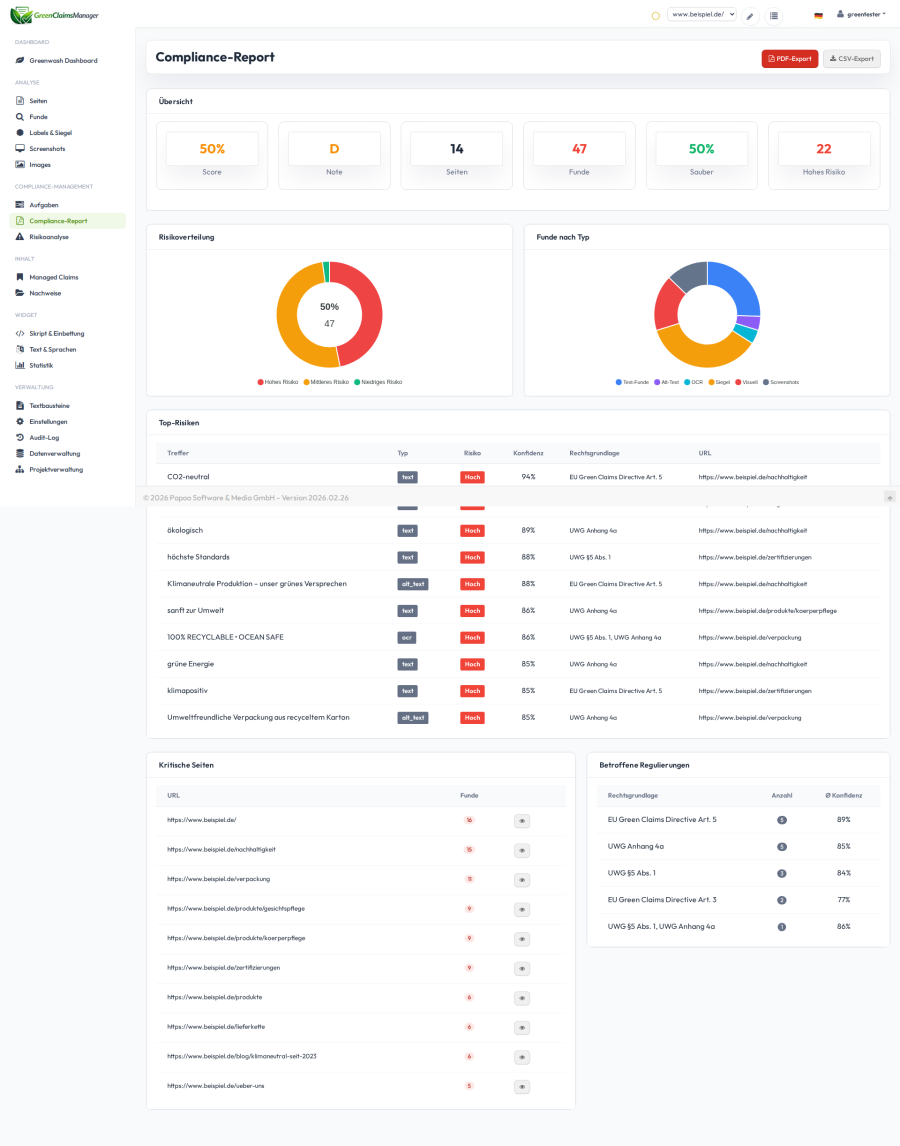
Provider’s perspective
The EmpCo Manager can organise possible findings, risk indicators and confidence levels for internal review. Those responsible then add the facts, the sources and the specialist decision.
To assess an individual advertising claim, involve the responsible experts and, where necessary, a lawyer specialising in unfair competition or consumer law in the Member State concerned.
The next step
A scan can show which publicly accessible pages may merit a closer internal review.
This page is for general information only and does not constitute legal advice. National rules implementing EU law may differ between Member States. For a binding assessment of a specific advertising claim, please consult a lawyer qualified in the Member State concerned.
 Bearbeiten